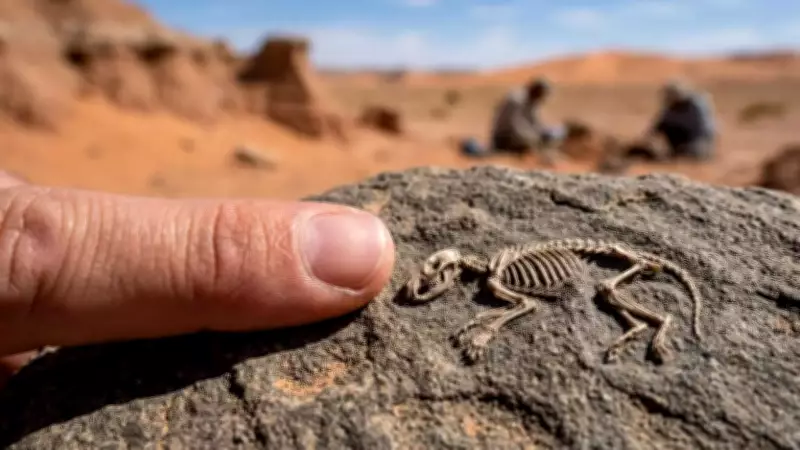
1-Centimeter Fossil Found in Gobi Desert: A Rare Glimpse into Late Cretaceous Micro-Mammals
In a groundbreaking discovery, palaeontologists have unearthed an exceptionally well-preserved fossil skeleton measuring a mere 1 centimetre in length in the Ukhaa Tolgod region of the Gobi Desert. This tiny fossil is believed to be one of the earliest known examples of 'micro-mammals' from the Late Cretaceous period, dating back approximately 75 to 100 million years.
Rarity of the Discovery
The American Museum of Natural History (AMNH), which participated in the Mongolian-America Museum Expedition (MAME), emphasizes that finding a complete and articulated skeleton at such a minuscule size—comparable to a fingernail—is exceedingly uncommon. While isolated teeth are more frequently discovered, intact fossils of delicate creatures like this are rare due to their fragility and susceptibility to natural destruction over millions of years.
This discovery marks a 'first of very few' for the Gobi Desert, an area renowned for its large dinosaur fossils. The fossil closely resembles a shrew and is classified as an advanced Mesozoic insectivore, a stem-mammal that coexisted with dinosaurs such as the Velociraptor.

How the Fossil Survived
The preservation of such a fragile skeleton is attributed to a process known as 'protracted aridification.' Research indicates that the Gobi Basin experienced intercontinental aridification around 75 to 100 million years ago, driven by the uplift of nearby mountain ranges. Small animals caught in massive sandstorms were rapidly buried in fine, dry sand, which acted as a natural 'time capsule.'
This quick burial process prevented decay and erosion, safeguarding the tiny bones for nearly 100 million years and providing a unique window into ancient ecosystems.
Life in an Extreme Climate
The 1-centimeter fossil offers evidence of how organisms adapted to the harsh, seasonal environment of the Gobi Desert. As the region dried up, insect-eating mammals evolved to survive without access to fresh water. The Eastern Gobi Basin, identified as one of the intercontinental areas most affected by climate change, provides context for how early mammals endured extreme global warming events.
Studying the Tiny Fossil
Due to its size and fragility, traditional tools like hammers and chisels are unsuitable for examining this fossil. Instead, scientists are employing High-Resolution Micro-CT Scanning to peer through the rock and create a detailed digital 3D model. This 'Digital Twin' of the skeleton allows for global study while preserving the original specimen, enabling analysis of intricate features such as teeth and inner ear structures.
This innovative approach highlights advancements in palaeontological technology, facilitating deeper insights into ancient life forms without physical damage.