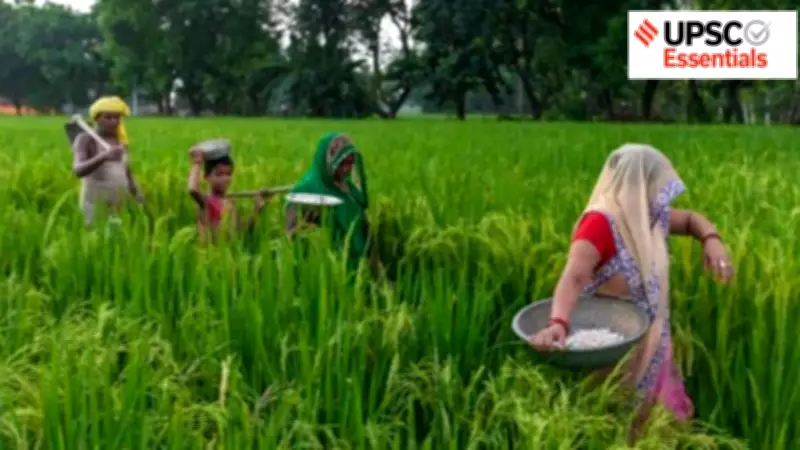
Women Farmers: The Unseen Pillars of India's Agricultural Landscape
As the Union Budget 2026-27 introduces ambitious initiatives like Bharat-VISTAAR and SHE-Marts alongside the United Nations declaring 2026 as the International Year of the Woman Farmer, attention turns to the complex realities facing India's female agricultural workforce. While policy frameworks increasingly recognize women's empowerment as crucial for national development, ground-level challenges persist in data visibility, resource access, and structural barriers.
The Historical Evolution of Women in Agricultural Narratives
For decades, mainstream agricultural discourse viewed peasant family farms as male-headed enterprises, with women and children playing secondary roles. This perspective underwent radical transformation following Danish economist Ester Boserup's groundbreaking 1970 work Woman's Role in Economic Development, which demonstrated that men are not always primary farmers. Boserup's research became foundational for the UN Decade for Women (1976-1985) and catalyzed the Women in Development approach, fundamentally shifting global policy toward integrating women into development narratives.
These new approaches revealed that family-based farming operates through gender-based division of labor that varies significantly across cultures and regions. Two critical concepts emerged from this understanding: the recognition of women as independent farmers and the acknowledgment of female-headed households as distinct agricultural entities.

The Dual Phenomenon: Greying and Feminization of Agriculture
Globally, women constitute approximately 40 percent of the agricultural labor force, but in India, this figure reaches a staggering 80 percent of economically active agricultural workers. Recent data reveals a significant trend: women's share in India's agricultural workforce has increased from 57 percent in 2017-18 to 64.4 percent in 2023-24, while men's participation has declined from 40.2 percent to 36.3 percent during the same period.
This shift relates directly to what economists term the "greying of agriculture" – a phenomenon where farmers are aging while younger generations, particularly educated men, move away from farming toward rural non-farm work or urban migration. This trend mirrors patterns observed across developing nations like Thailand and Vietnam, where agricultural labor undergoes similar demographic transformations.
For women, however, limited non-farm opportunities create a different reality. Approximately 87 percent of unpaid women workers in rural household enterprises engage in agriculture and allied activities. While female labor force participation has increased in recent years, this growth primarily stems from rising self-employment in agriculture, particularly through unpaid helper roles in family enterprises. These unpaid helpers often remain invisible in both data collection and policy formulation, creating significant gaps in understanding and addressing their needs.
Invisibility, Resource Access, and Structural Challenges
Gender and development scholars have long documented the existence of female-headed households in rural areas, often resulting from capitalist development, proletarianization, and male migration. In India, such households emerge through two primary pathways: de jure female-headed households resulting from widowhood, separation, divorce, or disability; and de facto households created by male migration.
Across rural India, men increasingly pursue circular or seasonal migration driven by multiple factors including agricultural slowdowns, rising input costs, climate-related crop risks, employment limitations, and growing aspirations among educated rural youth. These trends are particularly visible across the Global South, where farms are becoming smaller and more numerous due to land fragmentation.
As cultivation alone becomes insufficient for family sustenance, women frequently become sole farmers on fragmented lands, creating a direct link between agricultural greying and feminization. Research indicates that women farmers demonstrate greater willingness to adopt new agricultural activities and engage in crop diversification. Additionally, women form the backbone of livestock rearing, performing over 70 percent of work in dairy and animal husbandry sectors.

Despite these substantial contributions, women remain largely invisible and undercounted in agricultural and livestock statistics. This statistical invisibility significantly impacts asset ownership and resource access. According to UN data, rural women own only 15 percent of agricultural land in India. While feminist interventions have encouraged collection of sex-disaggregated land ownership data, challenges persist in distinguishing between joint and single ownership, often obscuring women's actual control and decision-making power over land resources.
Climate Vulnerability and Technological Interventions
Any comprehensive discussion of women farmers must address their disproportionate vulnerability to climate change impacts. Reports indicate that female-headed households suffer substantial economic losses annually – approximately 37 billion dollars from heat stress and 16 billion dollars from flood damage globally.
Technological interventions offer promising pathways for reducing women's agricultural burdens and vulnerabilities. Paddy cultivation provides a compelling case study: women cultivators frequently face health risks including skin issues, dehydration, allergies, and water-borne diseases alongside physically demanding labor. Adoption of technologies like direct-seeded rice (DSR), where seeds are sown directly rather than through seedling transplantation, can significantly reduce women's labor burden while decreasing water usage and greenhouse gas emissions. Given that paddy cultivation accounts for approximately 48 percent of agricultural greenhouse emissions, such technologies offer environmental and social benefits.
While debates continue regarding mechanization's impact on women's labor, evidence suggests that appropriately designed and implemented technologies can help women farmers overcome multiple structural constraints. The UN estimates that equal access to productive resources could increase farm yields by 20-30 percent, potentially feeding an additional 100 to 150 million people worldwide.
Pathways Forward: Ensuring Women's Agency in Agriculture
As 2026 approaches as the International Year of the Woman Farmer, comprehensive strategies must address multiple dimensions of women's agricultural participation. Beyond improving data visibility and sex-disaggregated data collection, investments in care infrastructure, secure land rights, credit access, and gender-responsive technologies are equally crucial for ensuring women's agency in agriculture.
The convergence of budget initiatives, international recognition, and ground realities creates a pivotal moment for transforming India's agricultural landscape. By addressing structural barriers and leveraging women's substantial contributions, India can build more resilient, equitable, and productive agricultural systems that recognize women farmers not as invisible helpers but as central anchors of the nation's food security and rural economy.