

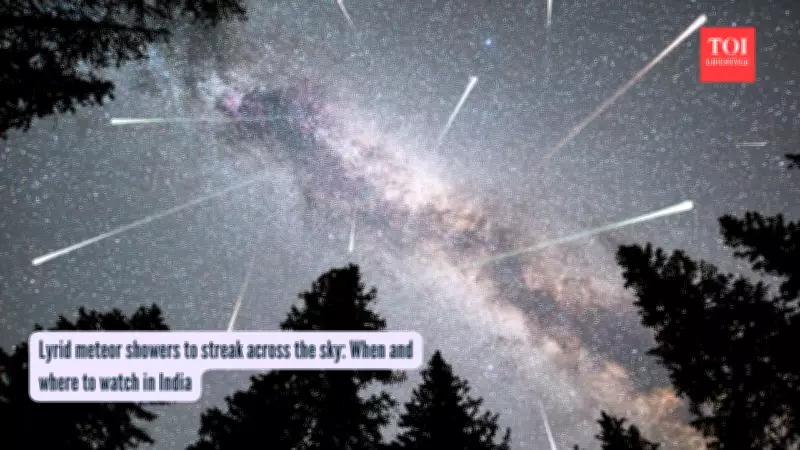
There is something quietly magical about watching pieces of a comet light up our sky as brief, glowing streaks. In April 2026, the sky is ready to put on a show for enthusiasts yet again, this time in the form of the Lyrid meteor shower, one of the oldest known "shooting star" displays in human records.
As Earth passes through the dusty trail of Comet Thatcher, tiny debris fragments burn up in the atmosphere, creating bright flashes visible from many parts of the world. Astronomers say the Lyrids are praised not just for their steady rate of meteors, but also for the occasional spectacular "fireball" that can linger in memory long after it vanishes.
What are the Lyrids?
NASA says that the Lyrids are fast, bright meteors linked to the long‑period comet C/1861 G1 Thatcher, which orbits the Sun roughly every 415.5 years. Recently, NASA astronaut Jessica Meir shared a rare image of the Lyrid meteor shower taken from the cupola window of the International Space Station, giving viewers a unique "from orbit" perspective of these streaks.

According to NASA material describing the image, Lyrids "do not typically have long, glowing dust trains when they streak through the skies," but they can still produce "an occasional bright flash called a fireball." So if you see a very bright, fiery streak in the sky on one of these April nights, you are likely watching a Lyrid fireball.
When can you see the Lyrids in India?
The Lyrid meteor shower officially runs roughly from April 16 to April 25 every year, and in 2026 its peak is expected around the night of April 21 into the early morning of April 22, with April 23 also offering a very good viewing window. Under ideal conditions, observers may see around 10–20 meteors per hour.
In India, the best time to watch is generally between midnight and sunrise, roughly 12 midnight to 5 am IST, with the peak visibility often occurring between 3 am and 5 am. Northern and central regions, such as Delhi, Mumbai, and Bengaluru, are some favourable spots for casual skywatching.
Tips for watching Lyrids from India
Lyrids are best viewed from the Northern Hemisphere, and India lies in a favourable zone for this year's display. To maximise your chances, experts recommend heading to a dark, open area away from city lights and light pollution, such as a rural field or an open rooftop with minimal nearby streetlights.
NASA suggests that you lie on your back, let your eyes adjust to the dark for at least 20–30 minutes, and look generally toward the eastern part of the sky. The Lyrids appear to radiate from near the constellation Lyra and its bright star Vega, a point called the "radiant," but astronomers advise not staring directly at Vega. Let your gaze rest at a point a little away from Lyra, and you will start noticing longer, more graceful streaks across the sky.






