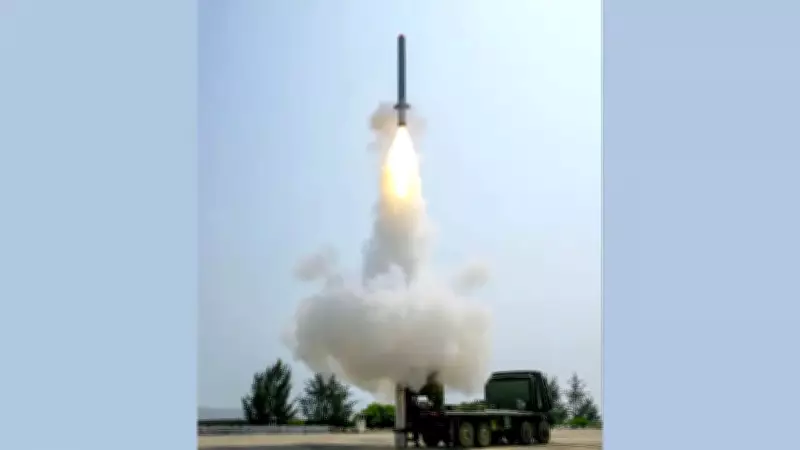
In a significant advancement for India's missile development, the Defence Research and Development Organisation (DRDO) successfully conducted a flight-test of the Long Range Land Attack Cruise Missile (LRLACM) on Monday. The test was carried out from Dr APJ Abdul Kalam Island off the coast of Odisha.
Indigenous Cruise Missile Programme
The LRLACM is an indigenous, next-generation cruise missile designed for precision strikes against high-value land targets. According to a defence ministry release, all test objectives were fully met, as confirmed by data captured through various tracking instruments deployed by the Integrated Test Range in Chandipur.
Range and Precision
With an expected range of up to 1,500 km, the LRLACM is capable of striking targets at long distances with pinpoint accuracy. It is widely regarded as India's equivalent to the US Tomahawk missile, as both are subsonic, low-flying, and highly precise, designed to hit land targets from extended ranges.

This subsonic cruise missile programme aims to equip the Indian armed forces with the ability to target critical land-based assets from safe distances, allowing launch platforms and personnel to remain outside heavily fortified areas. The missile can destroy key military targets such as command centers, communication hubs, airfields, and logistics facilities without endangering friendly troops.
Development and Collaboration
All subsystems of the LRLACM have been developed by various DRDO laboratories and Indian industry partners. The Aeronautical Development Establishment in Bengaluru served as the nodal laboratory for the project.
Defence Minister Rajnath Singh congratulated the DRDO team and industry partners on the successful flight-test. Defence Secretary and DRDO Chairman Rajesh Kumar Singh monitored all activities during the launch and congratulated the team members involved. The launch was witnessed by senior DRDO officials and user representatives from the Indian Navy and Indian Air Force.