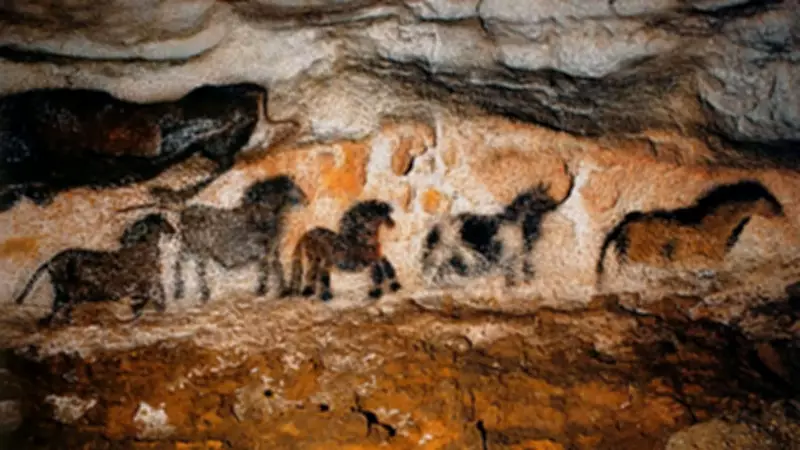
In southwestern France, in 1940, amidst the turmoil of World War II, four local teenagers and their dog named Robot made an accidental discovery that would become one of the greatest archaeological finds of the 20th century. While walking in the woods, Marcel Ravidat's dog Robot disappeared into a hole near a fallen tree. The next day, Marcel returned with his friends Jacques Marsal, Georges Agnel, and Simon Coencas to investigate. Initially thinking the hole might lead to a secret tunnel from a nearby chateau—stories of hidden passages were common during the war—they rigged makeshift ropes and lamps, squeezed into the shaft, and found themselves in a cave whose walls were covered in stunning prehistoric paintings.
The Discovery of Lascaux Cave
What they saw inside was mind-blowing: giant black bulls, wild horses, deer, and strange symbols, all painted in vivid colors that had survived for millennia. Historians later called Lascaux the "Sistine Chapel of Prehistory" due to the power and movement of the images. The boys ran to tell their teacher, Léon Laval, and soon local experts and archaeologists like Henri Breuil arrived, recognizing the significance of the find. Scientists confirmed the paintings dated back about 17,000 years to the Magdalenian people, with nearly 2,000 images including animals, abstract shapes, and a few human forms. The most famous section is the Hall of the Bulls, featuring giant wild cattle stretching up to five meters long.
Techniques and Significance
The artists used minerals like charcoal, manganese, and iron oxide for black, red, and yellow pigments. They skillfully utilized the natural bulges and dips of the cave walls to create a sense of movement, and even built scaffolds to reach high areas. These paintings forced historians to reconsider the capabilities of ancient humans, suggesting complex rituals, spirituality, or storytelling. One enigmatic scene depicts a wounded bison, a bird-headed figure, and a spear, sparking endless debate among archaeologists.

Preservation and Public Access
After World War II, Lascaux became a major tourist attraction, drawing thousands of visitors annually. However, human breath, heat, and sweat caused carbon dioxide buildup, algae, and fungus, damaging the art. In 1963, France closed the cave to the public to preserve it. Today, only a few scientists are allowed inside under strict supervision. Most visitors experience detailed replicas—Lascaux II, III, and IV—which are so accurate they feel almost real.
Legacy of the Discovery
Lascaux changed perceptions of Stone Age humans, revealing their creativity, observation skills, and storytelling talent. The story of the boys and their dog Robot remains a testament to serendipity: a group of kids with homemade ropes and a dog named Robot stumbled upon a treasure that reshaped our understanding of human history. Jacques Marsal later became a guide at Lascaux, and Simon Coencas often expressed disbelief at their luck. This discovery reminds us that sometimes the greatest finds come from the most unexpected places.