

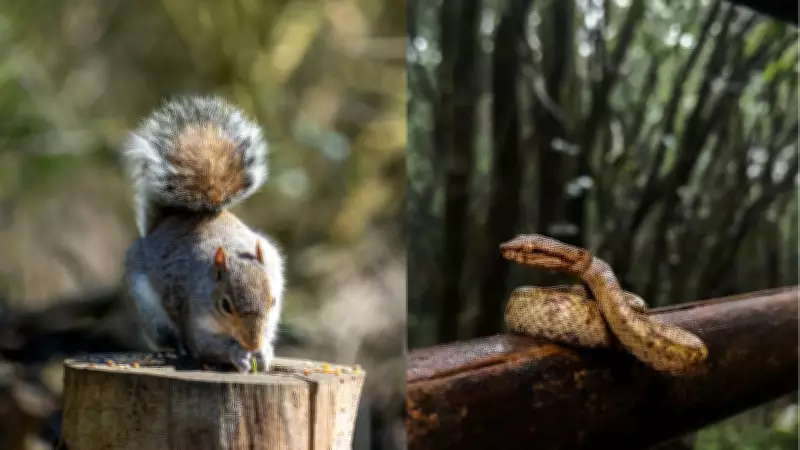
Ground Squirrels' Ingenious Survival Tactic: Chemical Camouflage
In the natural world, survival often depends more on intelligence than brute strength. A fascinating example of this principle can be found in ground squirrels, which have developed a remarkable defense strategy: they deliberately smell like their predators. Rather than fleeing from snakes, these small mammals employ what scientists call chemical camouflage, choosing to emit rattlesnake scent to avoid detection.
What Is Chemical Camouflage in Animals?
The term "chemical camouflage" describes an organism's ability to conceal its natural scent. While visual camouflage is widely understood, scent-based camouflage receives less attention despite being equally effective for survival. For ground squirrels, this involves "application of foreign scent"—using odors from other species to enhance their chances of staying alive.
According to research from the University of California, this represents "a novel antipredator defence founded on exploitation of a foreign scent." This indicates that squirrels aren't merely hiding but actively altering how predators perceive them.

Why Do Squirrels Smell Like Snakes?
A University of California, Davis study revealed that California ground squirrels and rock squirrels chew on shed rattlesnake skins and then lick their fur to distribute the scent across their bodies. This behavior offers multiple advantages:
- Concealing Natural Odor: It helps mask their presence, particularly when resting in dens.
- Confusing Predators: Snakes may mistake the squirrel for another snake, reducing their likelihood of attacking.
- Protecting Vulnerable Individuals: Young and female squirrels, who face higher predation risks, frequently use this method.
Researcher Donald Owings noted, "It's a nice example of the opportunism of animals… they're turning the tables on the snake."
How This Behavior Works in Practice
The process is surprisingly straightforward yet highly effective:
- Squirrels locate shed snake skins or areas where snakes have been present.
- They chew these materials to release scent compounds.
- They lick and spread the scent across their coats.
Scientists have observed that squirrels can also gather snake odor from soil or surfaces, not exclusively from skins. Experimental studies further demonstrate that rattlesnakes show greater attraction to pure squirrel scent than to mixtures combining squirrel and snake odors.
A Comprehensive Survival Arsenal Against Snakes
Chemical camouflage represents just one component of ground squirrels' multifaceted defense strategies against snakes. These rodents have evolved several additional protective measures:
- They can use their tails to emit infrared warning signals to snakes.
- They assess danger levels by interpreting sounds produced by snakes.
- Some exhibit resistance to snake venom.
These defense mechanisms highlight the prolonged evolutionary conflict between squirrels and snakes.
What This Reveals About Nature
The ability of animals to alter their scent challenges traditional notions of camouflage. This phenomenon illustrates how survival isn't solely about concealment but can involve sophisticated deception at sensory levels we rarely consider.
More significantly, it exemplifies how adaptation in the animal kingdom extends beyond environmental factors to include interactions with other species. Despite being rodents, ground squirrels demonstrate a complex survival system.
The squirrels' deliberate adoption of snake scent showcases nature's creativity, particularly regarding survival tactics. By utilizing chemical camouflage, these animals reduce predation risks and enhance their survival prospects in a predator-rich world. This serves as a powerful reminder that evolution favors not just strength but also creativity, flexibility, and the capacity to transform an enemy's advantage into one's own.






