

February's Celestial Parade: A Six-Planet Alignment Unfolds Across Evening Skies
As February evenings unfold, a remarkable celestial event is quietly taking shape across the night sky. Rather than a fleeting spectacle confined to a single date, this planetary alignment presents itself as a gradual, extended display that rewards patient observers with its subtle beauty.
A Slow Seasonal Shift in the Heavens
The planetary lineup, often described by astronomers as a planetary parade, becomes visible soon after sunset and stretches across much of the sky. Unlike dramatic astronomical events that peak on specific nights, this display unfolds gradually throughout the month, creating what National Geographic characterizes as an extended viewing period rather than a single highlight date.
From around February 20 into early March, up to six planets can be traced across the evening sky:

- Jupiter
- Mercury
- Neptune
- Saturn
- Uranus
- Venus
Navigating the Celestial Arrangement
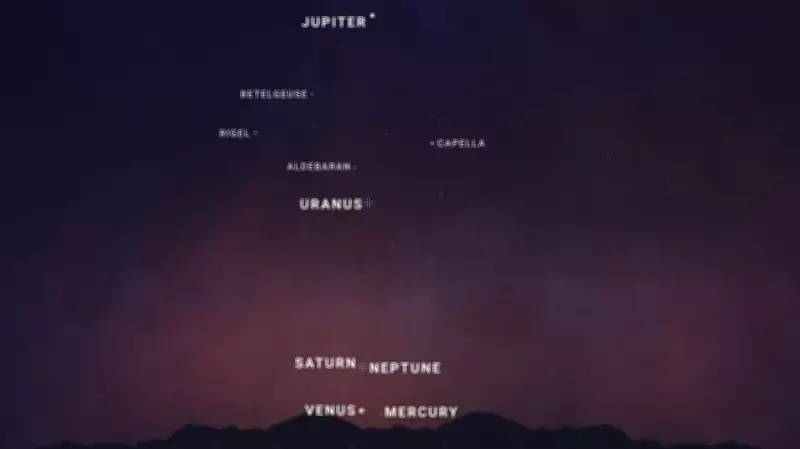
The planetary distribution creates a fascinating pattern across the heavens. Venus, Mercury, and Saturn cluster low above the western horizon, setting relatively soon after dusk. Venus serves as the standout object in this western group, bright enough to be visible even before the sky fully darkens. Mercury appears nearby but lower and fainter, while Saturn lingers close to the horizon, typically setting within an hour of sunset.
Jupiter occupies a different position entirely, appearing about halfway up the eastern sky. Its steady brightness and higher position make it easily recognizable, and its separation from the western planetary cluster helps create a wide arc across the sky, enhancing the sense of scale for this celestial event.
Visibility Conditions and Equipment Requirements
With clear skies and minimal light pollution, several planets become visible to the naked eye during this alignment:
- Jupiter
- Mercury
- Saturn
- Venus
However, the more distant planets require optical assistance for proper observation:
- Neptune travels near Saturn but remains faint
- Uranus sits high in the southern sky near the Pleiades star cluster
Both Neptune and Uranus require binoculars or a telescope for clear viewing, though NASA includes them in the lineup to emphasize the full extent of this celestial alignment.
Optimal Viewing Strategies
National Geographic emphasizes that this is primarily an early evening display best seen shortly after sunset. The most rewarding views typically come later in February when more planets become visible during the same evening window. As the planets drift slowly across the sky, the view changes night by night, offering different perspectives throughout the observation period.
The best impressions generally occur soon after dusk when the sky has darkened sufficiently but the lower planets haven't yet set below the horizon. Success in observing this celestial event depends on several factors:
- Clear weather conditions
- Minimal light pollution
- A clear view of the horizon
- Proper timing after sunset
- Patience and extended observation
A Celestial Event That Rewards Patience
This planetary alignment represents a different kind of astronomical experience—one that unfolds gradually rather than appearing as a momentary spectacle. Jupiter's position remains fairly consistent through the month, acting as a visual anchor for the entire parade. The changing positions of the other planets become noticeable with regular observation, particularly for those who take the time to track their movements across successive evenings.
As February transitions into March, this celestial display offers skywatchers a unique opportunity to witness the slow dance of our solar system's planets across the evening sky, reminding us of the constant, graceful movements occurring just beyond our atmosphere.






