

Pune's uGMRT Telescope Captures Monster Black Hole Waking Up After 100 Million Years' Silence
In a groundbreaking astronomical discovery, the upgraded Giant Metrewave Radio Telescope (uGMRT) located near Pune has captured a rare cosmic event: a monster black hole "waking up" after an estimated 100 million years of silence. This observation provides unprecedented insights into the life cycles of supermassive black holes.
Discovery of a Giant Radio Galaxy
Astronomers using the uGMRT and other powerful telescopes have identified a "giant" radio galaxy named J1007+3540. This galaxy spans over 3 million light-years, making it approximately 50 times wider than our Milky Way. The research team, led by Dr. Sabyasachi Pal from Midnapore City College in West Bengal and including Shobha Kumari as lead author, utilized the unique low-frequency capabilities of the uGMRT operated by the National Centre for Radio Astrophysics – Tata Institute of Fundamental Research in Pune.
The findings were recently published in the prestigious Monthly Notices of the Royal Astronomical Society, highlighting the significance of this discovery in the field of astronomy.

A Violent Cosmic Environment
Dr. Pal explained that this galaxy resides in a hostile "galaxy cluster," a crowded region filled with searing-hot gas that creates immense pressure. "Our research shows how extreme cosmic pressure in a galaxy cluster is physically sculpting these fresh energy jets," he said. This environment acts like a heavy atmosphere, crushing everything inside it and leading to a violent struggle between the black hole's power and the surrounding forces.
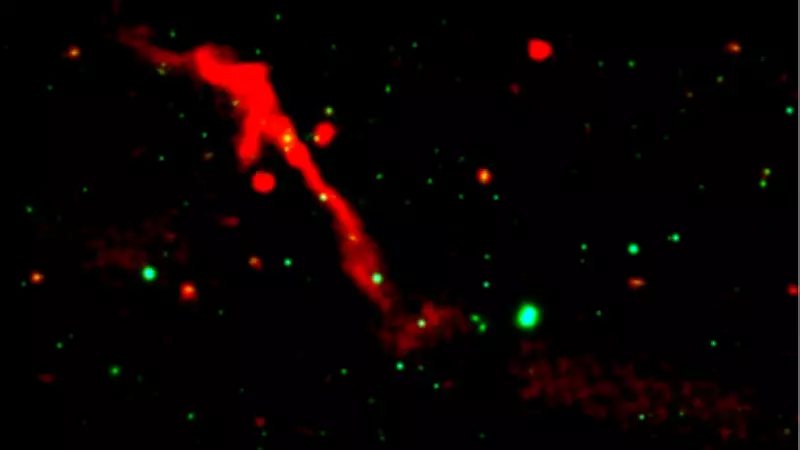
The radio images reveal a "double-double" structure, with bright, fresh energy jets nested inside older, fainter ones. This structure confirms that the central black hole has recently re-ignited after a long period of dormancy. As the new jets blast outward, they are pushed sideways by the intense pressure, creating striking curved shapes and leaving behind a wispy "galactic wake" millions of years old.
Scientific Implications and Global Collaboration
This discovery is part of a global effort involving experts from India and Poland, including Dr. Surajit Paul from Manipal Centre for Natural Sciences and Dr. Marek Jamrozy from Jagiellonian University. By studying this unique system, scientists can now observe the full life cycle of supermassive black holes—from how they power up to how they fall silent and eventually "wake up" again.
The uGMRT's low-frequency Band 3 (250–500 MHz) imaging was crucial in tracing extended diffuse emissions and understanding the spectral properties of the source. This helped astronomers analyze the ageing nature of radio emissions in different regions of the galaxy.
Dr. Pal emphasized that this galaxy serves as a natural laboratory, allowing scientists to study how black holes turn on and off and how they shape the universe around them. He described it as "a violent, beautiful 'tug-of-war' between the power of a black hole and the crushing weight of deep space."
This discovery not only advances our understanding of cosmic phenomena but also showcases India's growing role in cutting-edge astronomical research, with Pune's uGMRT playing a pivotal role in unlocking the mysteries of the universe.






