

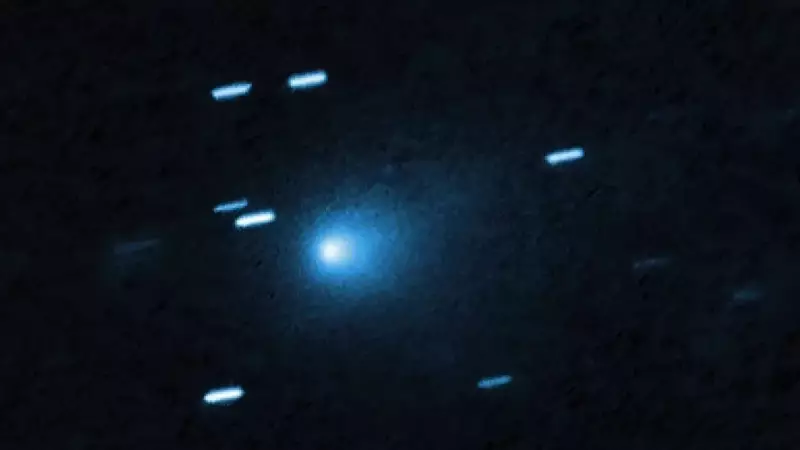
The American space agency NASA is preparing to showcase never-before-seen photographs of the mysterious interstellar visitor known as Comet 3I/ATLAS. This extraordinary celestial object has captured global attention due to its unusual characteristics and the fascinating theory that it might be an alien spacecraft exploring our solar system.
The Great Reveal: NASA's Live Event Details
NASA has organized a special live broadcasting event scheduled for November 19 at 3 pm EST (1:30 am IST on November 20). The presentation will originate from the Goddard Space Flight Center and feature images collected from various NASA missions that have been tracking the comet's journey through our solar system.
Space enthusiasts can watch this historic reveal through multiple platforms including NASA+, the NASA app, the agency's official website, YouTube channel, and Amazon Prime. For those wishing to participate more actively, NASA has provided an email address - molly.l.wasser@nasa.gov - where viewers can register by sending their full name, media organization, email address, and phone number at least two hours before the event begins.

The agency is also encouraging public engagement through social media, inviting people to submit their questions using the hashtag #AskNASA. Selected questions will be addressed during the live broadcast, making this an interactive experience for astronomy fans worldwide.
Why Comet 3I/ATLAS Has Scientists Buzzing
Comet 3I/ATLAS represents only the third confirmed object to enter our solar system from interstellar space, making it an extraordinary scientific discovery. What makes this comet particularly intriguing to astronomers and astrophysicists are its bizarre properties that defy conventional understanding of cometary behavior.
Harvard astrophysicist Avi Loeb has emerged as a prominent voice in the scientific discussion surrounding the comet. He has pointed out several anomalous characteristics that suggest the object might not be of natural origin. Among these unusual features are the comet's strange tail orientation and a peculiar plume that releases approximately four grams of nickel per second without any corresponding iron - a chemical process never before observed in comets.
Additional puzzling aspects include the comet's atypical nongravitational acceleration and its trajectory that will bring it close to major planets in our solar system. These peculiarities gained widespread public attention following a popular podcast episode that featured detailed discussions about the comet's mysterious properties.
Elon Musk Weighs In on Alien Theory
The conversation about Comet 3I/ATLAS reached mainstream audiences when Tesla CEO Elon Musk discussed the object during an appearance on Joe Rogan's podcast. The discussion centered around the detection of nickel in the comet's gas cloud and its potential implications.
While Rogan noted that nickel has common industrial applications on Earth, Musk offered a more measured perspective. He acknowledged that the comet might be influenced by forces other than gravity but also provided a simpler explanation, pointing out that many comets and asteroids naturally contain nickel deposits. Musk humorously remarked that if the comet were indeed an alien spacecraft built from nickel, it would be rather cumbersome and potentially destructive if it collided with Earth.
In a more serious tone, Musk promised that if he ever obtained objective evidence of extraterrestrial life, he would reveal it on Rogan's show. The billionaire entrepreneur also made the curious public statement that he is "never committing suicide," though the context of this remark remains unclear.
Scientific Significance and Safety Assurance
Despite the exciting speculation about its origins, NASA has confirmed that Comet 3I/ATLAS poses absolutely no danger to Earth. The closest approach the comet will make to our planet is approximately 170 million miles, ensuring a safe distance throughout its passage through our solar system.
In early October, the comet came within 19 million miles of Mars, providing an excellent opportunity for observation. NASA missions captured imagery as the object traveled through the inner solar system, and these photographs will form the core of the upcoming presentation.

The comprehensive imaging campaign employed different instruments and vantage points from both spacecraft throughout the solar system and ground-based observatories. This multi-perspective approach allows scientists to study how the comet behaves from various angles, potentially unlocking secrets about its composition and origin.
As the scientific community eagerly awaits NASA's revelation, Comet 3I/ATLAS continues to challenge our understanding of interstellar objects and what they might tell us about the universe beyond our solar system. Whether it proves to be a naturally occurring celestial body or something more extraordinary remains to be seen, but its journey through our cosmic neighborhood promises to expand human knowledge regardless of its ultimate nature.





