Uber Shuttle Service Halt Forces 30,000 Kolkata IT Commuters to Seek Alternatives
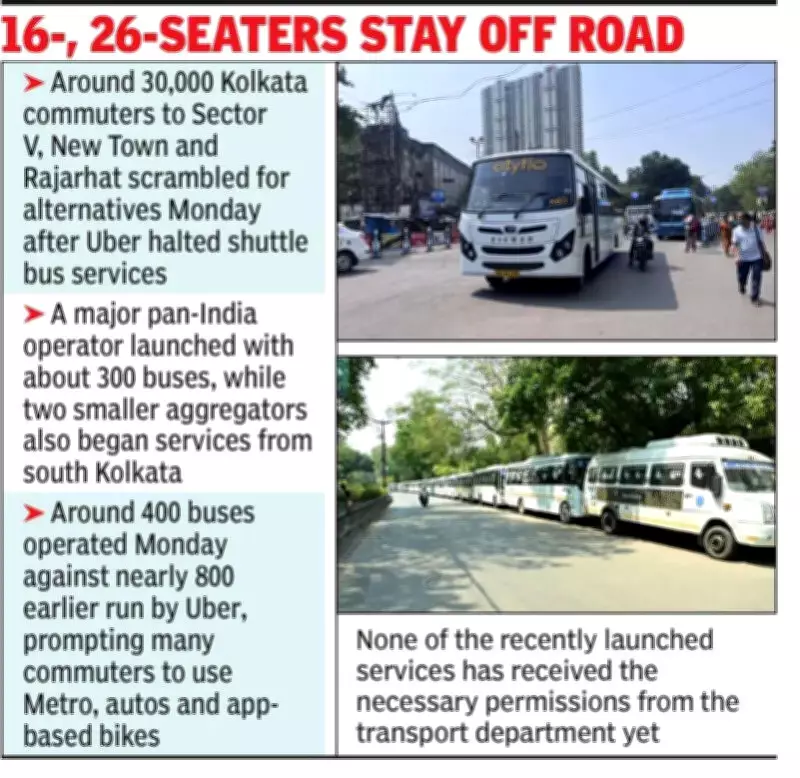
In a significant disruption to daily travel routines, approximately 30,000 shuttle bus commuters in Kolkata were compelled to alter their commute plans on Monday. This upheaval followed Uber's decision to cease its shuttle bus services, which had been a lifeline for many traveling to the key IT hubs of Sector V, Newtown, and Rajarhat. Uber, however, emphasized that all its other transportation options remained operational as usual for commuters.
New Aggregators Launch Amid Service Shortfall
In response to the gap left by Uber, at least one major pan-India company, which had initially planned a May launch, debuted in the city with around 300 buses. Additionally, two smaller aggregators announced their presence from multiple locations in south Kolkata, bringing the total number of new buses to approximately 400. Despite these efforts, the numbers fell short of previous capacity. Uber alone had operated 800 shuttle buses, leaving only about 400-plus buses on the roads on Monday.
To bridge this deficit, app-based bike services stepped in, arranging pickups from origin points such as Ranikuthi, Tollygunge Metro, and Behala Chowrasta. A large number of these bikes were also observed waiting outside Karunamoyee and Sector V stations, providing a stopgap solution for stranded commuters.

Regulatory and Operational Challenges Persist
Questions linger regarding the availability and legality of these new services. None have yet received the necessary permissions from the transport department, raising concerns about their sustainability. Furthermore, the larger aggregator opted for 40-seater buses, leaving the more popular 16- and 26-seater variants off the road. These smaller buses are favored for their quicker travel times, adding to commuter frustrations.
Industry leaders, such as Indranil Banerjee, convener of the West Bengal Online Cab Operators' Guild, have called for immediate government intervention to address payment issues and ensure smoother operations. "There should be immediate govt intervention to sort out payment issues," Banerjee stated, highlighting the need for regulatory support in this transition period.
Commuters Adapt with Mixed Reactions
Commuters shared varied experiences with the new services. Anamika Karmakar, who traveled from Sakuntala Park to Unitech in New Town, noted, "I took the new service from Greenfield City and since this was a promotional ride, it was pocket-friendly. It was a glitch-free ride and it seems they have entered the market after completing their study." However, she expressed concerns about the cost of passes, describing them as "a bit on the high side."
A top official from one of the new companies addressed pricing concerns, stating, "After a decade of operations, we've learned that pricing must work for both customers and operators from the start, because unsustainable pricing often leads to abrupt shutdowns, operational lapses, and eventually stranded commuters. We're building for the long term, which means holding ourselves to a high bar on timeliness, support and predictability for customers."
Alternative Commute Strategies Emerge
Some commuters turned to other modes of transport. Saptak Bhattacharya from Kamalgazi opted for the Metro, taking the Blue Line followed by the Green Line, and then hailing an auto or app bike for last-mile connectivity. "It took me a few extra minutes but was ultimately a viable alternative," he remarked.
Other alternatives saw high demand, such as 14-seater SUV shuttle services from Behala Chowrasta, which were popular until 9 am, and AC buses from WBTC running full from areas like Rajchandrapur and Barrackpore. Meanwhile, several commuters adopted a wait-and-watch approach. Tanusree Haldar, a Jadavpur resident working in New Town, shared, "I took a work-from-home option for Monday and took the feedback from colleagues. I will analyse and take the final call on booking a new shuttle service from Tuesday."
This shift in Kolkata's commute landscape underscores the challenges and adaptations in urban transportation, as new players enter the market amidst regulatory uncertainties and commuter preferences evolve.