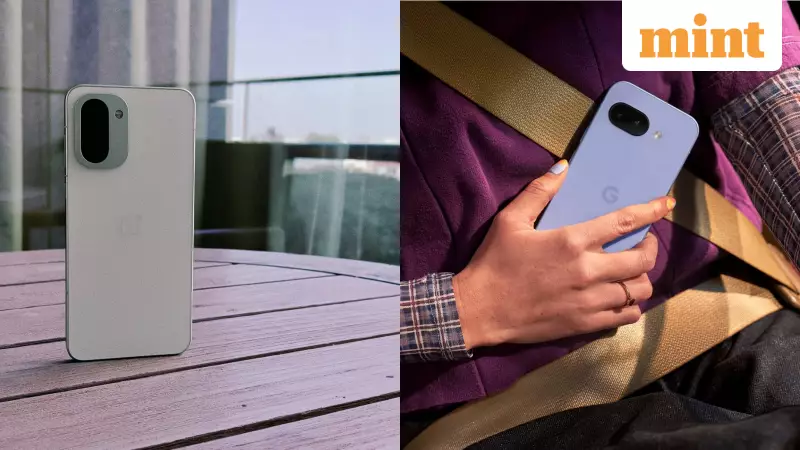
In the fiercely competitive Indian smartphone market, a new battle for supremacy has ignited in the sub-₹50,000 segment. OnePlus has officially unveiled its latest 'value flagship', the OnePlus 15R, positioning it as the direct rival to Google's popular entry-level flagship, the Pixel 9a. Both phones aim to deliver premium experiences without the premium price tag, but they take distinctly different approaches. This in-depth analysis will help you decide which device makes the most sense for your needs and budget.
Price and Positioning: The Initial Skirmish
The pricing strategy is the first major point of differentiation. The OnePlus 15R has been launched with a starting price of ₹47,999 for the variant with 12GB of RAM and 256GB of storage. However, with attractive launch offers and discounts, the effective purchase price for consumers can drop to around ₹44,999, making it an aggressive contender.
On the other side, the Google Pixel 9a entered the market earlier this year at ₹49,999 for its base model. Since its release, market dynamics have adjusted its street price, and it now consistently retails in the ₹42,000 to ₹45,000 range. This brings both phones into a direct and intense price collision, setting the stage for a feature-by-feature war.

Hardware and Performance: Raw Power vs. AI Optimization
Under the hood, the two phones are powered by completely different philosophies. The OnePlus 15R is a powerhouse, equipped with the cutting-edge Qualcomm Snapdragon 8 Gen 5 processor. This chipset represents a significant generational leap over its predecessor and is complemented by dedicated co-processors for Wi-Fi and touch response. OnePlus claims these chips enhance network speeds and provide a super-responsive, low-latency scrolling experience, crucial for gamers and power users.
The Pixel 9a, in contrast, relies on Google's in-house Tensor G4 chipset. While this silicon enables many of Google's exclusive AI and photography features, it has faced criticism in past iterations for thermal management and cannot match the sheer computational throughput of the Snapdragon 8 Gen 5. For users prioritizing raw performance for gaming, multitasking, and heavy applications, the OnePlus 15R holds a clear advantage.
Display and Build: Big, Bold, and Tough vs. Compact and Classic
The visual and physical experience offered by these phones is starkly different. The OnePlus 15R features a large, immersive 6.83-inch 1.5K LTPS AMOLED display with a blistering 165Hz refresh rate for ultra-smooth visuals. It is protected by Corning Gorilla 7i glass. More impressively, it boasts top-tier durability with IP68, IP69, and IP69k ratings for resistance against dust, water immersion, and even high-pressure, high-temperature water jets—a first for a smartphone in this class.
Google's Pixel 9a opts for a more compact and traditional form factor with a 6.3-inch Full HD+ OLED display offering a 120Hz refresh rate. While its build quality is solid, it lacks the extreme ruggedness certification of its rival. The choice here is between a large, ultra-smooth, and incredibly durable canvas on the 15R and a smaller, still-excellent screen that's easier to handle with one hand on the Pixel 9a.
Battery, Charging, and Software Support
OnePlus has made a monumental leap in battery capacity with the 15R, packing a massive 7,400mAh battery—the largest ever in a OnePlus phone. It supports incredibly fast 80W wired charging, promising minimal downtime. The Pixel 9a, meanwhile, is equipped with a 5,100mAh battery and supports significantly slower 23W wired charging and 7.5W wireless charging. Notably, Google does not include a charger in the box. While the Pixel offers wireless charging—a feature absent on the 15R—the sheer size and speed of the OnePlus battery solution are overwhelming.

The software battle presents another interesting trade-off. The OnePlus 15R runs OxygenOS 16 based on Android 16, featuring a fluid interface rich with customization options for the lock screen, charging animations, and more. It includes AI features like Eraser and Portrait Glow. OnePlus promises 4 years of OS updates and 6 years of security patches.
The Pixel 9a runs pure, stock Android and comes with Google's unparalleled promise of 7 years of both OS updates and security patches. Pixel devices are always the first to receive the latest Android versions and often get exclusive access to new Google AI features months before other brands. However, the UI offers far fewer customization options compared to OxygenOS.
Camera Capabilities: Specs vs. Software Magic
On paper, the OnePlus 15R seems to have the edge. It sports a 50MP Sony IMX906 primary sensor paired with an 8MP ultra-wide lens. For selfies, it uses a 32MP front camera with autofocus, capable of recording 4K video at 120fps.
The Pixel 9a counters with a 48MP main camera and a 13MP ultra-wide sensor, along with a 13MP selfie shooter that records 4K video at 30fps. While its hardware specs appear modest, Google's reputation for computational photography is legendary. The Pixel's software optimization often produces stunning images that can rival or surpass phones with superior hardware. A definitive verdict on camera performance requires hands-on testing, but the Pixel's software prowess cannot be underestimated.
Verdict: Which Phone Should You Choose?
Your ideal choice hinges entirely on your personal priorities as a user.
Choose the OnePlus 15R if: You are a power user or mobile gamer who demands the absolute best performance. Its Snapdragon 8 Gen 5 chipset, gigantic 7,400mAh battery with 80W charging, large 165Hz display, and exceptional IP69k durability make it a performance beast and a true 'flagship killer' in this price bracket.
Choose the Google Pixel 9a if: You value longevity, pure software, and cutting-edge AI. The promise of 7 years of updates is unmatched. If you prefer a more compact phone, want to be the first to try Google's new AI features, and trust in its legendary camera software to deliver excellent photos, the Pixel 9a remains a compelling and unique option.
In the sub-₹50,000 arena, the OnePlus 15R emerges as the new hardware champion, while the Pixel 9a retains its crown for software support and AI integration. The ball is now in the consumer's court.