

Tricity to Witness Final Act of Total Lunar Eclipse on Tuesday Evening
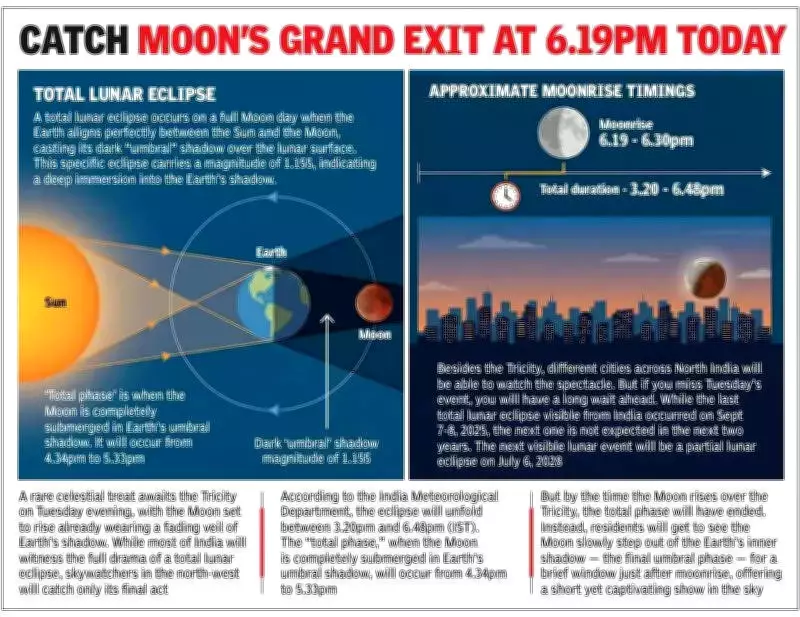
A rare celestial spectacle is set to grace the skies over the Tricity on Tuesday evening, offering skywatchers a unique opportunity to observe the Moon rising while still partially cloaked in Earth's shadow. While most parts of India will experience the complete drama of a total lunar eclipse, residents in the northwestern region, including Chandigarh, will only witness the concluding phase—a brief but mesmerizing view of the Moon stepping out of darkness.
Eclipse Timings and Visibility Details
According to the India Meteorological Department, the lunar eclipse will unfold between 3:20 PM and 6:48 PM Indian Standard Time (IST). The total phase, during which the Moon is entirely immersed in Earth's umbral shadow, is scheduled from 4:34 PM to 5:33 PM. However, by the time the Moon ascends over the Tricity, this total phase will have concluded. Instead, observers will be treated to the final umbral phase, where the Moon gradually emerges from the inner shadow, creating a short yet captivating display in the eastern sky just after moonrise.
Approximate Moonrise Timings for Key Cities
- Chandigarh: 6:19 PM
- Amritsar: 6:30 PM
- Jalandhar: 6:25 PM
- Delhi/North Haryana: 6:20–6:25 PM
Science Behind the Celestial Event
A total lunar eclipse occurs on a full Moon day when the Earth aligns perfectly between the Sun and the Moon, casting its dark umbral shadow across the lunar surface. This particular eclipse boasts a magnitude of 1.155, indicating a deep immersion into Earth's shadow, which enhances its visual appeal. The phenomenon is a testament to the intricate dance of celestial bodies and offers a glimpse into the mechanics of our solar system.

Future Lunar Events and Viewing Opportunities
If you miss Tuesday's eclipse, be prepared for a significant wait. The last total lunar eclipse visible from India took place on September 7-8, 2025, and the next one is not anticipated for over two years. The subsequent visible lunar event will be a partial lunar eclipse on July 6, 2028, making this week's occurrence a rare and valuable viewing opportunity for astronomy enthusiasts in the region.






