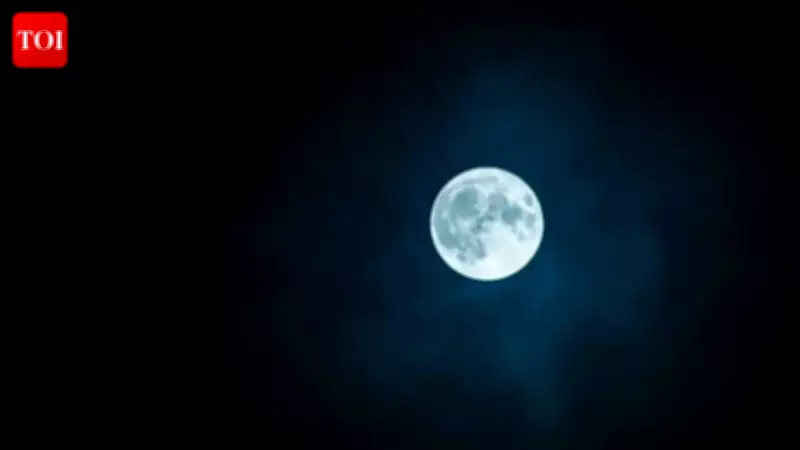
You have seen the silver orb, witnessed the blood moon, and been stunned by the orange hue. Now, get ready for one of the sky's headline acts this weekend: a rare 'Blue Moon' that is set to rise on May 31.
Sure, the name might suggest that the moon will turn into a blue ball overnight, but do not be fooled. You will not actually see a blue-colored moon. 'Blue Moon' simply means something special is happening with the lunar calendar, and it only comes around every few years. It is a treat for both seasoned stargazers and anyone who likes to look up.
What Makes This Blue Moon Special?
This year's Blue Moon is pulling double duty: it is not only triggering a special occasion on the lunar calendar but also appearing as a 'micromoon.' The moon will be a bit farther from Earth than usual, making it look slightly smaller and dimmer than a normal full moon. While the change may not be immediately noticeable, astronomers say having a Blue Moon and a micromoon at the same time is actually quite rare.

What Is a Blue Moon?
A Blue Moon occurs when there are two full moons in a single month. We had a full moon on May 1, and we are getting a second one on May 31. Since the moon takes about 29 and a half days to cycle through its phases, this does not happen often, just every couple of years. The last time this occurred was in August 2023, and the next opportunity will be in December 2028.
The phrase 'once in a blue moon' originates from this phenomenon. While it is not the rarest event in space, it is unusual enough to generate excitement whenever it appears.
How to Watch the Blue Moon
If you want to catch the moon at its brightest, it will peak around 8:45 a.m. Coordinated Universal Time (UTC) on May 31. In India, that is about 2:15 p.m. Indian Standard Time (IST). However, you do not need to check your watch precisely. The real show is during moonrise, right after sunset, when the moon is close to the horizon. That is when it looks biggest and most dramatic.
In India, the Blue Moon will be visible on the evening of May 31, as long as clouds cooperate. For the best view, find an open spot with an unobstructed view of the eastern horizon, away from city lights. Beaches, rooftops, fields, or hills are ideal for moon-watching.
Moonrise times vary by location, but in major cities like Kolkata, Delhi, Mumbai, Bengaluru, and Chennai, you should see it just after sunset. For exact timings, check local listings.
In the UK, the moon will reach peak illumination at 09:45 British Summer Time (BST) on Sunday morning, when it will be below the horizon. For the best viewing experience, head outside during evening twilight or throughout the night to see the moon fully illuminated.
For photographers, the best time to snap the moon is during twilight, just as it is rising. The sky still has some color, which helps balance out the moon's brightness in your photos. Use a tripod and a zoom lens if available, but a modern smartphone can also perform well.
More About the Blue Moon
The moment the moon first lifts above the horizon always carries a touch of magic. Because of how sunlight passes through Earth's atmosphere at that angle, the moon can glow gold, orange, or even reddish. This optical trick, known as the 'Moon Illusion,' makes the moon appear bigger and more colorful than when it is high in the sky, even during a so-called Blue Moon.
There is even more happening overhead. The Blue Moon will drift close to the bright star Antares in Scorpius. If you are lucky, you might spot Venus, Jupiter, or Mercury adding extra sparkle to your evening stargazing session.
This micromoon is due to the moon's elliptical orbit. It swings closer to and farther from Earth every month. When a full moon occurs at the far point, it is called a micromoon. This May 31 Blue Moon will be about 406,000 kilometers away, making it the most distant full moon of the year.