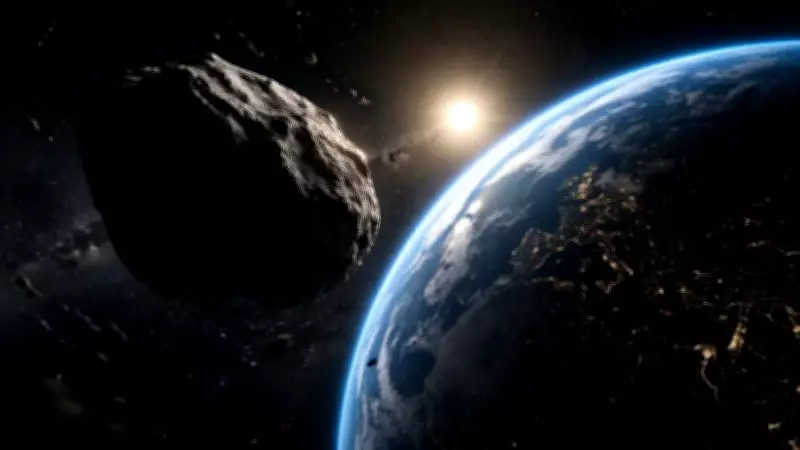
NASA Monitors Small Asteroid 2026 HJ1 for Safe Earth Approach in 2026
According to data reportedly shared by NASA, a small near-earth asteroid is expected to make a close pass by Earth on April 21, 2026. The object, identified as 2026 HJ1, is being actively monitored by astronomers using specialized telescopes. This event is part of the regular stream of space objects that periodically move through Earth's orbital region, drawing attention due to the often concerning term "asteroid near Earth." However, experts emphasize that such occurrences are not unusual and happen frequently, with most going unnoticed by the public.
Asteroid 2026 HJ1: Size and Characteristics
Asteroid 2026 HJ1 is estimated to be approximately 23 feet wide, roughly the size of a small bus. It falls under the category of near-earth objects, which are rocky remnants from the early solar system. These fragments continue to orbit the Sun, occasionally crossing paths close to Earth's orbit. Many such small asteroids pass near Earth regularly, with most being too small to cause concern or easily detected without advanced instruments. This particular asteroid has been catalogued and tracked in advance, a standard procedure in modern astronomy that ensures accurate monitoring of its trajectory.
Why Is This Asteroid Approaching Earth?
The movement of 2026 HJ1 is linked to its natural elliptical orbit, which can stretch far and wide around the Sun. At certain points, these orbits bring objects closer to Earth's orbital path. Gravitational forces from the Sun and other planets play a significant role in shaping these trajectories. Over long periods, slight changes can bring asteroids into near-earth zones. Monitoring agencies have reported nothing unusual in terms of behavior or structure for this asteroid, confirming its routine nature.

No Impact Risk Confirmed by Experts
Asteroid 2026 HJ1 is not considered a threat to Earth. Reports indicate it will pass at a distance of roughly 400,000 miles, which is about 1.6 times the distance between Earth and the Moon. This distance is significant in astronomical terms—close, but still safely away. Experts confirm there is no collision risk. If an object of similar size were to enter Earth's atmosphere, it would most likely break apart due to frictional heating before reaching the surface. However, in this case, even that scenario does not apply, as the trajectory keeps it well outside Earth's atmosphere. Such flybys are tracked, logged, and studied, but they typically do not lead to any physical consequences for the planet.
Why Near-Earth Asteroids Are Common
Near-earth asteroids are not rare events; Earth experiences multiple close approaches every month. Most of these objects are small, and many go unnoticed by the public. They travel through space continuously, with some passing quietly at safe distances and others detected only after they have moved away. These fragments are leftovers from early planetary formation, still orbiting the Sun in various paths and speeds, contributing to the dynamic nature of our solar system.
How NASA Tracks Objects Like 2026 HJ1
NASA and other space agencies maintain constant surveillance of near-earth objects using telescopes and tracking systems. These tools monitor size, speed, orbit, and distance from Earth, helping scientists calculate whether any object could pose a future risk. So far, 2026 HJ1 has shown no dangerous trajectory. These monitoring systems are part of broader planetary defense efforts, allowing early detection of objects that might require attention in the future. For now, 2026 HJ1 remains just another recorded flyby—a small object moving past Earth on its usual orbital path, observed and tracked as part of ongoing space monitoring work.