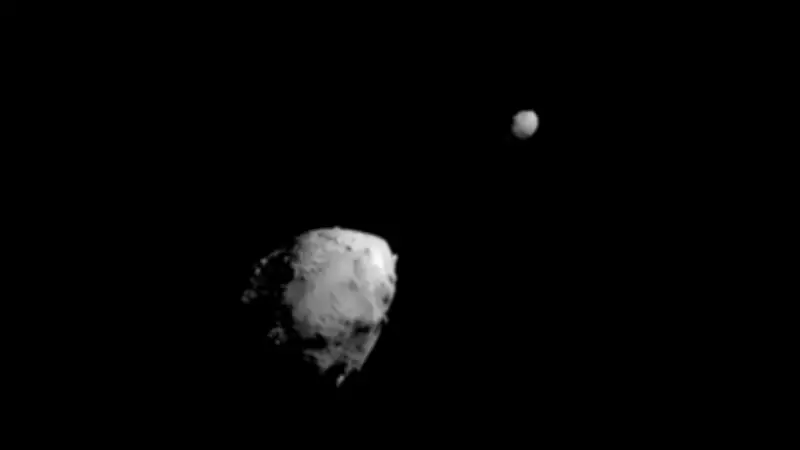
NASA's DART Mission Achieves Unprecedented Solar Orbit Shift in Asteroid System
In 2022, NASA executed a dramatic spacecraft collision with an asteroid, an event that seemed straight out of a science fiction movie. The mission, known as the Double Asteroid Redirection Test (DART), aimed to address a critical question: could humanity deflect an asteroid if it ever posed a threat to Earth? Initially, scientists focused on how the impact altered the orbit of the small asteroid Dimorphos around its larger partner, Didymos.
Surprising Discovery: Solar Orbit Altered by Human Intervention
Now, researchers reveal that the impact may have achieved something even more remarkable. New observations indicate the crash slightly changed the entire binary asteroid system's orbit around the Sun. This shift is minuscule, almost imperceptible, but experts hail it as the first measurable alteration of a natural celestial body's solar orbit by a human-made spacecraft.
Details of the DART Impact and Its Effects
The DART spacecraft intentionally collided with Dimorphos in September 2022 at a staggering speed of approximately 22,500 kilometers per hour. Dimorphos, measuring about 170 meters across, orbits the much larger Didymos, which is around 805 meters wide. Together, they form a binary asteroid system, gravitationally linked so that changes to one affect the entire system.

Upon impact, the collision ejected a massive cloud of rock and dust into space, reshaping part of Dimorphos's surface. Scientists were surprised by the volume of debris, which carried momentum away from the asteroid, creating an additional push known as the "momentum enhancement factor." Essentially, the debris acted like a natural rocket exhaust, amplifying the spacecraft's impact.
Measurable Changes in Orbital Dynamics
Previous studies confirmed that the impact significantly shortened Dimorphos's orbit around Didymos from roughly 12 hours to about 33 minutes less. This result demonstrated the feasibility of altering an asteroid's motion with a spacecraft.
The new research shows a subtler effect: the Didymos-Dimorphos system's solar orbit changed by approximately 0.15 seconds. In astronomical terms, even such a small shift is meaningful. Researchers estimate the system's speed altered by roughly 11.7 microns per second, equivalent to about 1.7 inches per hour. While this adjustment is incredibly slow, over extended periods, it could lead to substantial orbital deflections.
Future Implications for Planetary Defense
The DART mission serves as the first practical test of asteroid-deflection technology, paving the way for enhanced planetary defense strategies. NASA is already advancing with the Near-Earth Object Surveyor mission, a specialized space telescope designed to detect hard-to-see asteroids. Many potentially hazardous objects are dark and reflect minimal sunlight, making them challenging to identify with traditional telescopes.
This breakthrough underscores humanity's growing capability to protect Earth from cosmic threats, marking a historic step in space exploration and safety.