NASA's Artemis II Mission Releases Breathtaking Earth-Moon Flyby Images
NASA has unveiled a stunning collection of images captured during the historic Artemis II mission flyby, providing unprecedented views of Earth and the Moon from deep space. The photographs, taken by the Orion spacecraft and its crew, offer a rare perspective on our celestial neighbors.
Moon, Earth and Orion in One Frame
A striking composite image reveals the Moon and Earth together in a single frame. Sunlight illuminates the right side of NASA's Orion spacecraft, while a waxing crescent Moon dominates the background. A much smaller crescent Earth appears to descend toward the Moon's horizon on the right, creating a celestial spectacle rarely witnessed by human eyes.
Total Solar Eclipse from Deep Space
From the astronauts' perspective during the flyby, this remarkable image captures the Moon fully eclipsing the Sun, creating 54 minutes of totality. Visible stars, planets and the Sun's glowing corona—the outer atmosphere—highlight a deep-space perspective impossible to achieve from Earth's surface.

Choreographed Camera Work
Artemis II pilot Victor Glover and mission specialist Christina Koch meticulously documented the lunar surface during their approximately seven-hour flyby. The crew took turns at Orion's windows as they passed around the Moon's far side, coming as close as 6,545 kilometers above its surface, capturing both images and scientific observations.
Shadows Across Vavilov Crater
A detailed close-up of Vavilov Crater reveals the transition from smooth inner terrain to a rugged rim on the edge of the larger Hertzsprung basin. Long shadows along the Moon's terminator—captured with a handheld 400 mm lens—accentuate the dramatic lunar topography.
Sunlit Orion and Lunar Surface
Orion appears brilliantly sunlit in the foreground with a waxing gibbous Moon behind it. The 965-kilometer-wide Orientale basin sits near the center-bottom of the Moon, marking the boundary between the Moon's near side with dark lava plains and its far side.
Moon's Oldest Impact Basin
The view of the Moon's South Pole-Aitken basin shows heavily cratered terrain along its eastern edge, with the day-night boundary casting dramatic shadows. As the largest and oldest basin on the Moon, this region reveals billions of years of lunar geologic history.
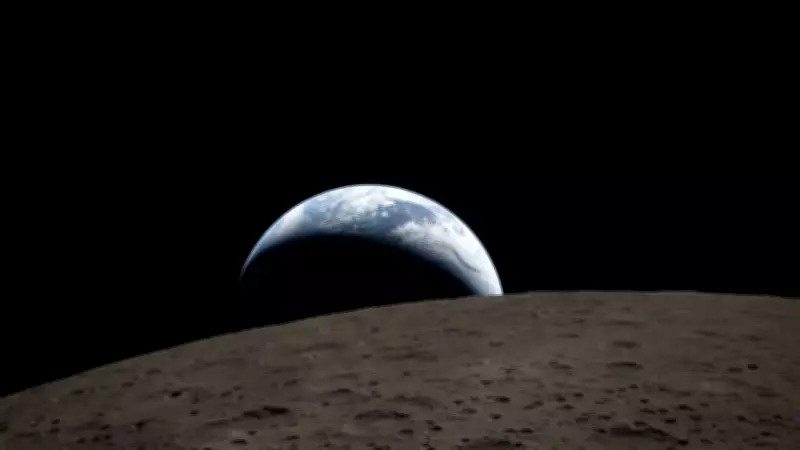
Earthset Over the Moon
The Artemis II crew captured a series of images during their journey around the Moon, including this striking view of Earthset—the blue Earth appearing to set behind the Moon. The image reveals Earth's dark night side alongside a cloud-covered daytime over Australia, with the Moon's craters and jagged peaks clearly visible in the foreground.
Craters Along the Terminator
The Moon's terminator—the boundary between lunar day and night—comes alive under low-angle sunlight, casting long shadows that reveal the true shapes and depths of its craters. Since the earliest days of telescopic observation, this boundary has been invaluable to scientists for observing and mapping the Moon's rugged terrain.
These images represent a significant milestone in space exploration, providing both scientific data and public inspiration as NASA prepares for future crewed missions to the Moon and beyond.