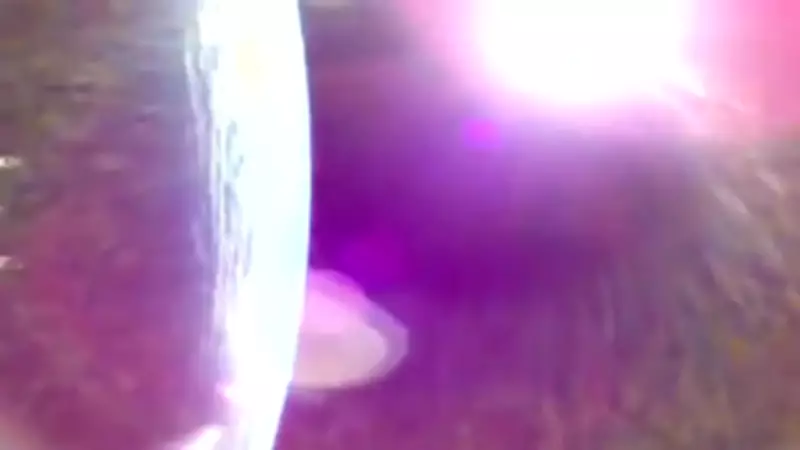
NASA's Artemis II Orion Spacecraft Engine Ignition Captured in Historic Video
A newly released video from NASA captures a defining moment of the Artemis II mission: the powerful ignition of the Orion spacecraft's main engine. The footage, shared by the space agency on social media platforms, shows the service module engine firing in the vast expanse of deep space. This event represents a crucial milestone as the spacecraft officially begins its ambitious journey toward the Moon.
The Critical Translunar Injection Burn
The Orion spacecraft ignited its main engine for an impressive duration of nearly six minutes, generating approximately 6,000 pounds of thrust. This powerful maneuver successfully placed the astronauts on a precise trajectory toward the Moon and established what NASA calls a 'free return trajectory.' This orbital path allows the spacecraft to loop around the Moon using its gravitational pull before safely returning to Earth.
After receiving official clearance with a "Go" from mission control, Orion fired its engine for five minutes and 50 seconds to complete the translunar injection (TLI) burn. This critical operation pushed the spacecraft out of Earth's orbit and onto its designated path toward the lunar destination.

At the time of the engine burn, Orion weighed approximately 58,000 pounds and consumed nearly 1,000 pounds of fuel. According to NASA's official release, the engine's thrust is so remarkably powerful that it compares to accelerating a standard automobile from 0 to 60 miles per hour in just under three seconds. This moment carries particular historical significance as it marks humanity's return to deep space travel beyond low-Earth orbit for the first time since the final Apollo mission in 1972.
Life Aboard Orion During the Journey
While the engine burn established the spacecraft's course, life inside Orion continues with a focus on maintaining crew health and mission readiness. The astronauts are utilizing a compact flywheel exercise device specifically designed to help them maintain physical fitness in microgravity conditions.
Unlike the International Space Station, which accommodates large and heavy workout equipment, Orion carries a significantly smaller exercise system. Weighing only about 30 pounds and roughly the size of a standard carry-on suitcase, this innovative device still enables astronauts to perform essential exercises including rowing motions, squats, and deadlifts, generating resistance based on their physical effort.
Simultaneously, ground control teams are meticulously monitoring Orion's life-support systems to ensure the cabin environment remains breathable and comfortable for the crew. Even minor technical issues, such as a brief communication interruption that occurred after reaching orbit, were promptly identified and resolved without any impact on the overall mission objectives.
Preparing for a Historic Lunar Flyby
Following the successful engine burn, NASA's lunar science team has begun detailed planning for what the astronauts will observe during their upcoming flyby of the Moon. During a planned six-hour observation window, the crew will study various lunar features including craters, ancient lava flows, and surface fractures that contain valuable clues about the Moon's formation and the broader history of our solar system.
One of the most remarkable events anticipated during this observation phase will be a solar eclipse lasting nearly an hour. As the Sun moves behind the Moon from Orion's unique perspective, the crew will witness a dramatically darkened lunar surface and may potentially observe meteoroid impacts, dust movement patterns, and distant planets. They will also gain a rare view of the Sun's outer atmosphere, scientifically known as the corona.
Artemis II represents far more than just another spaceflight mission. The spacecraft carries four distinguished astronauts: Reid Wiseman, Victor Glover, Christina Koch, and Jeremy Hansen on an extraordinary journey spanning nearly 248,000 miles from Earth. The mission is scheduled to last approximately 10 days, taking the crew thousands of miles beyond the Moon before looping back to Earth utilizing the Moon's gravitational assistance.

Why This Engine Burn Matters Historically
The ignition of Orion's main engine transcends being merely a technical milestone. This moment fundamentally transforms Artemis II from an Earth-orbit mission into a genuine deep-space exploration journey. The successful burn validates the performance capabilities of both the Space Launch System rocket and the Orion spacecraft, systems specifically designed to carry human explorers farther into space than any mission since the Apollo era.
This critical maneuver also tests essential systems including navigation, propulsion, and life support—all vital components for future crewed missions. The success of this operation establishes a solid foundation for upcoming missions that aim to return humans to the lunar surface and eventually send astronauts to Mars, marking a new chapter in human space exploration.