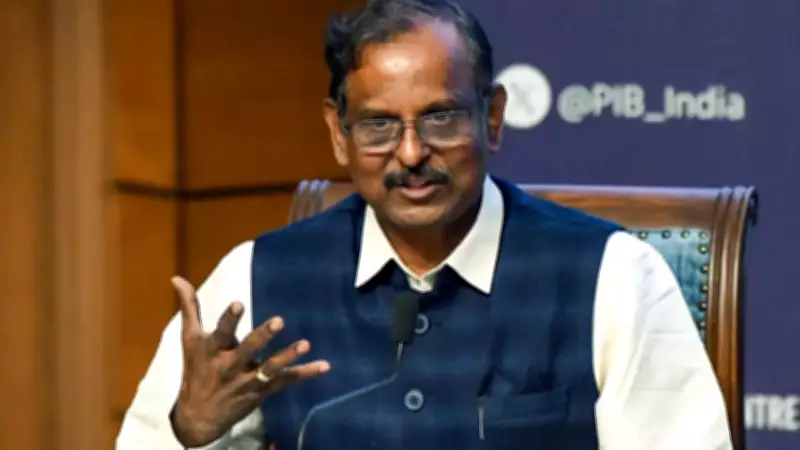
ISRO Chairman Highlights Critical Role of Mission Operations in India's Space Program
BENGALURU: While India's space missions often capture global attention during their dramatic liftoffs, the true test of success unfolds long after the rockets have fallen silent. According to ISRO Chairman V Narayanan, the future of the country's space ambitions hinges on mission operations—the prolonged, behind-the-scenes phase that ensures satellites and spacecraft function reliably for years, sometimes up to 15 years.
The Invisible Backbone of Space Missions
Speaking at the Spacecraft Mission Operations (SMOPs) conference, Narayanan underscored a stark contrast: launches typically last a mere 15 to 25 minutes, but spacecraft must operate flawlessly for extended periods in orbit. "Ensuring that the spacecraft remains fully operational in orbit requires continuous monitoring, simulations, and command operations. This is a very important domain," he stated, positioning mission operations at the core of India's upcoming space endeavors.
His remarks come at a pivotal time for ISRO, which has faced criticism due to recent launch failures and project delays. The Indian space program is transitioning from milestone-driven missions to sustained space activity, making operational excellence more critical than ever.

Recent Achievements and Complex Challenges
Narayanan highlighted three major accomplishments since the last SMOPs conference:
- The successful docking experiment in space, involving two satellites moving at speeds exceeding 15,000 kmph, which he described as particularly complex and risky. "Any wrong command... you know what will be the end result," he warned.
- The Chandrayaan-3 Moon landing, where mission operations teams executed an autonomous landing sequence near the lunar south pole.
- The Aditya-L1 solar mission, marking India's entry into an elite group of nations studying the Sun.
Collaborative Efforts and Technological Advancements
The chairman stressed that mission operations are not the responsibility of a single team but involve a collaborative effort among designers, software engineers, and systems specialists. He called their role "very significant" and often under-recognized in the public eye.
Looking ahead, Narayanan emphasized that emerging technologies will become indispensable. "What was considered advanced 10 to 15 years ago is now the need of the hour," he said, pointing to artificial intelligence, machine learning, and cloud-based ground systems as critical tools for future missions.
Expanding Ecosystem and Human Spaceflight
Narayanan also placed mission operations within the broader context of India's growing space ecosystem, noting increased participation from private players and startups. These entities are contributing to both technological capabilities and talent development, he added.
On human spaceflight—a program that has experienced multiple timeline shifts—Narayanan described it as "not just another activity" but a major step demanding sustained operational precision. Drawing a parallel to April 12, 1961, the date of the first human spaceflight, he highlighted India's preparations for its own crewed missions.
Future Directions and Operational Discipline
As ISRO advances toward more complex missions, including future Chandrayaan-4 and 5 projects and human spaceflight, Narayanan's message was unequivocal: success will depend less on the spectacle of launch and more on the disciplined, meticulous operations that follow. This shift in focus underscores a strategic evolution in India's approach to space exploration, where longevity and reliability in orbit take precedence over momentary triumphs.