

IISc Breakthrough: Magnetic Microbots Enable Precise Quantum Sensing Inside Cells
In a significant advancement for biological research, scientists from the Indian Institute of Science (IISc) have developed an innovative technique to actively steer quantum sensors through the complex, viscous environments of living cells. This development addresses a critical limitation in cellular analysis, where traditional nanoscale probes often drift aimlessly, relying on random encounters with target molecules.
Overcoming Cellular Crowding with Engineered Mobility
Cellular interiors are not empty spaces but rather crowded, gel-like matrices that hinder the free movement of tiny sensors. This restriction has long impeded accurate measurements of essential parameters such as temperature, viscosity, and chemical activity. The IISc team tackled this challenge by designing a system that actively transports the sensor to specific locations within cells, rather than passively waiting for molecules to approach.
At the core of this approach is a nanodiamond embedded with a nitrogen vacancy (NV) defect. This defect allows the sensor to detect environmental changes through quantum spin state shifts, which are readable via fluorescence. While such sensors are highly sensitive, positioning them effectively inside cells has been problematic. Previous methods used optical tweezers—tightly focused laser beams to trap and move particles—but these can damage delicate biological materials due to intense light exposure.

Magnetic Control for Safe and Precise Navigation
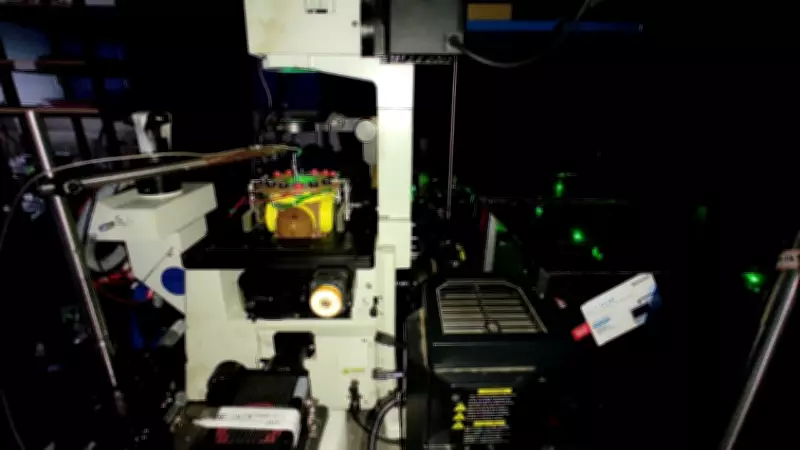
The IISc researchers circumvented this issue by attaching the nanodiamond to a helical microbot partially composed of iron. When subjected to a rotating magnetic field, the microbot spins and propels forward like a corkscrew, carrying the sensor along. This magnetic control enables precise three-dimensional movement without exposing cells to harmful light, with illumination required only during measurement moments to minimize heating and phototoxic effects.
Another obstacle at the nanoscale is Brownian motion, the random jostling caused by surrounding molecules that can disrupt sensor orientation and introduce noise. By aligning the microbot with an external magnetic field, the team successfully stabilized the sensor, suppressing this noise and enhancing measurement reliability.
Engineering Innovations and Future Applications
Designing this system involved careful engineering to avoid interference. Magnetic elements can distort sensor readings, so the researchers positioned the nanodiamond approximately a micron away from the microbot's iron head, where magnetic disturbances are minimal.
Professor Ambarish Ghosh from the Center for Nanoscience and Engineering (CeNSE) highlighted the platform's potential, stating, "We are able to counter Brownian motion with magnetic manipulation, making this approach more promising than optical or other techniques."
The researchers believe this platform could be used to track reactive oxygen species within cells, which are implicated in aging and diseases like cancer. More broadly, it offers a minimally invasive method for real-time measurements in previously inaccessible biological environments.
Published in Advanced Functional Materials, this study points toward a future where mobile quantum sensors can navigate intricate biological landscapes, providing new insights into dynamic cellular processes as they occur.






