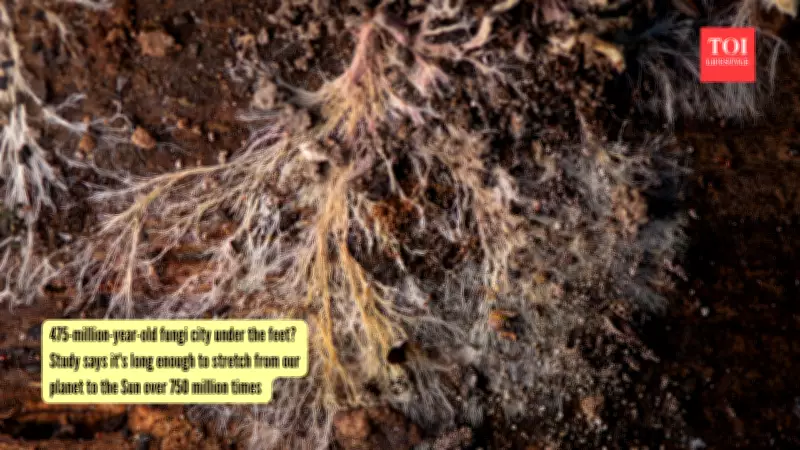
We tend to think of the ground beneath our feet as just a place to walk upon, something to wipe off our feet, dig a garden into, or pour concrete over to build cities. Most of us never give it a second thought. But soil is far from empty. Beneath every step you take lies a hidden, living world so vast and busy that scientists have only begun to truly understand it.
Massive Mycorrhizal Network Revealed
According to a study published in the journal Science, the soils of Earth contain enough subterranean fungi to stretch from our planet to the Sun almost 750 million times over. These are arbuscular mycorrhizal fungi, vast webs of microscopic, tubular threads called hyphae that have quietly sustained life on land for about 475 million years.
They form partnerships with more than 70% of the world's plants, trading nutrients and water for the carbon that plants pull from the air. In doing so, they also help cool the planet by locking carbon away in the soil.

Incredible Scale of the Network
Researchers calculated that, laid end to end, these fungal threads would run roughly 110 quadrillion kilometers, which is almost 750 million times the distance between Earth and the Sun. As lead author Dr. Justin Stewart said, there could be "up to 10 metres of mycorrhizal network in just a teaspoon of soil."
To build the first global map of this hidden infrastructure, a team from the Society for the Protection of Underground Networks (Spun), founded in 2021, studied data from more than 16,000 soil samples worldwide into machine-learning models. The map reveals where these networks thrive and, more worryingly, where they are under threat.
Human Activities Pose Major Threat
The study found that fungal networks in cropland are, on average, 47.3% less dense than in wild ecosystems. Much of the damage, according to Stewart, comes from intensive farming, especially tilling, which physically rips the soil apart, along with fertilizers and fungicides that disrupt the delicate partnership between plant and fungus.
The consequences of losing these networks could ripple far and wide. Thinner fungal webs mean soils that store less carbon, distribute fewer nutrients, and do a poorer job of shielding rivers and lakes from agricultural runoff. "If they disappear, there's going to be a lot more chemicals going into waterways," warned Dr. Toby Kiers, another author of the study.
Richest Hotspots Identified
The map also pinpoints the planet's richest underground hotspots. Grasslands, the researchers found, hold the densest networks of all, with regions such as Florida's Everglades, the Sudd wetlands of South Sudan, and prairie and steppe ecosystems showing exceptionally high density. Yet many of these areas are poorly protected and increasingly degraded.
The team hopes their findings will change how we farm and what we choose to protect. They argue that working with soil fungi, rather than against them, could help plants feed themselves naturally, cut fertilizer use, and trap more carbon underground.