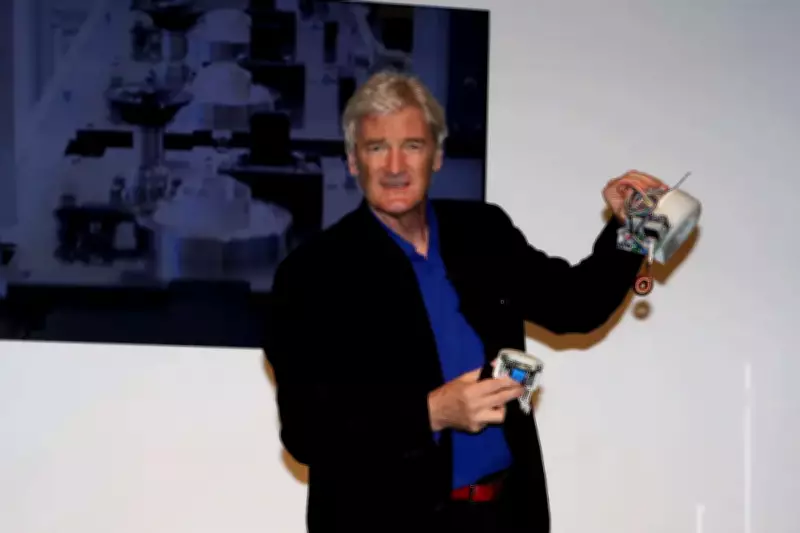
All of us have experienced the frustration of a noisy vacuum that fails to pick up dirt effectively. For most, it is a brief annoyance, but in 1978, during an afternoon break in the harvesting season, James Dyson became fascinated with this problem—a fascination that lasted nearly 15 years. He discovered an ironic flaw: the bag, designed to hold dirt, was actually the cause of the vacuum's inefficiency.
The Birth of a Revolutionary Idea
Instead of improving the existing design, Dyson looked to industrial solutions. He recalled the giant cyclone towers at sawmills, which used centrifugal force to separate sawdust from the air. He wondered if this powerful mechanism could be scaled down for home use. This was a bold move, as it meant abandoning the dominant bag system that had been used for a century. By analyzing household problems through an engineering lens, Dyson opened the door to a new way of thinking.
Physics of the Bagless Innovation
Transforming a persistent irritation into a functional device was not a fast journey. According to corporate history from Cambridge Judge Business School, Dyson spent about ten years developing his bagless vacuum concept while working part-time and refining earlier inventions. He famously tested over 5,000 prototypes before finding the optimal design. This highlights an important principle: overnight success is a fiction. From 1978 to 1993, Dyson dedicated 15 years to diligent experimentation until the invention became marketable.

The key innovation was applying cyclonic separation—a scientific technique that uses centrifugal force to eject dirt from the air stream. While Dyson did not invent the laws of physics, he was the first to realize they could solve the problem of clogging bags. The dirt was spun out to the outer wall of the container and fell into a collection canister, transforming suction power and airflow. His perseverance led to a revolutionary product that is now standard in modern vacuums.
Effectiveness of Technical Reasoning
Recent research continues to explore these mechanisms. A study published in ACS Omega confirms that cyclonic technologies effectively control particles and airflow. Dyson's 1978 prototype exemplifies putting well-established scientific concepts into practice. He recognized that vacuum bags were not optimal for filtration and replaced them with a separator—a deliberate attempt to solve an existing problem, not an accident.
Lab Tests and Worldwide Success
When Dyson's vacuum finally entered production in the early 1990s, its unique design and effectiveness attracted attention. It made such a strong impression that medical practitioners became interested. The dramatic change in suction and airflow led consumers to adapt to a revolutionary product.
The brand's success stemmed from solving a specific consumer problem: tool failures are noticeable, and vacuums without suction are particularly problematic. By addressing this single issue, Dyson created a useful product rather than a purely visual one. Historical data shows that Dyson's perseverance during the 1980s allowed him to remain financially independent. He had to be both an inventor and an enterprising entrepreneur, defending his patents and perfecting his designs.
Conclusion
In James Dyson's case, a simple question—'Why do we fail in this?'—led to an invention that revolutionized an industry. While most overlook such trivial household issues, Dyson chose to view it as a problem worth 15 years of his life. What was once considered the height of engineering is now a commonplace feature, showing that innovation sometimes results from looking at a malfunctioning device and deciding to create something better.