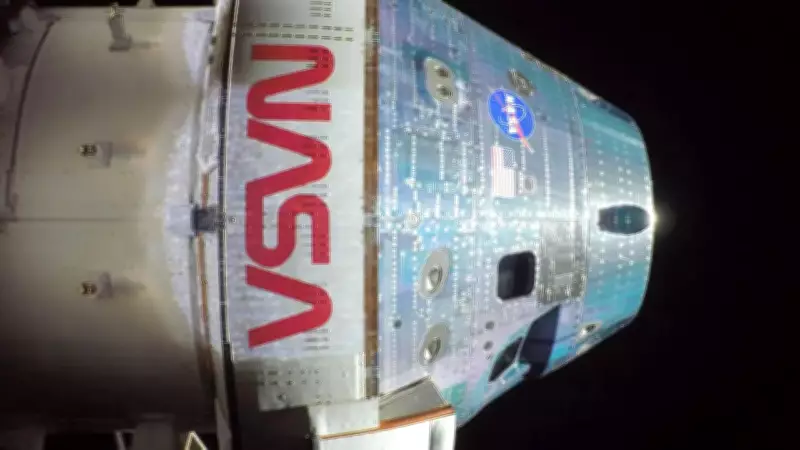
NASA's Artemis II Mission Unveils Unprecedented Earth Images from Deep Space
The Artemis II mission, a pivotal step in NASA's return of human exploration beyond Earth, has achieved a remarkable milestone by entering deep space. This historic phase has yielded stunning new photographs of our planet, captured from beyond low Earth orbit. These images, taken from the Orion spacecraft as it journeys toward the Moon, provide a clear and scientific record of Earth's appearance from a significant distance, marking a new era in space documentation.
Hello World: Auroral Activity and Visual Confirmation
One of the most captivating images released shows Earth positioned behind the spacecraft, with visible auroral activity near the polar regions. Auroras occur when charged particles from the Sun interact with Earth's magnetic field and atmosphere, and their presence in these photographs confirms favorable visibility conditions during the capture. This visual data not only enhances public engagement but also serves as a critical tool for mission tracking and analysis.
Mission Progress and Scientific Insights
Artemis II is progressing steadily according to schedule, with more updates expected as the spacecraft approaches the Moon. The images depict the terminator line on Earth, which marks the boundary between the light and dark sides of the planet. This feature is always visible when imaging planets and results from Earth's rotation and alignment with the Sun during photography. Such details offer valuable insights into observational conditions in deep space.

Crew and Mission Objectives
The Artemis II crew, consisting of Christina Koch, Victor Glover, Jeremy Hansen, and Reid Wiseman, launched earlier in the week as part of a planned ten-day mission. Notably, this mission does not include a lunar landing; its primary objectives are to test spacecraft systems, crew operations, and navigation capabilities under deep-space conditions. At the time of the update, the spacecraft had traveled more than 100,000 miles from Earth, showcasing the vast distances involved.
Support for Future Missions and Technical Analysis
These photographs, taken by Reid Wiseman following the completion of the translunar injection burn, are part of standard mission documentation. They provide visual confirmation of spacecraft orientation, environmental conditions, and observational data collected during transit. Released as part of routine updates, the images contribute to ongoing assessments of mission performance and help verify expected conditions during deep space travel. The Artemis II mission is intended to support future endeavors, including a lunar landing projected for later in the decade.
Key Highlights of the Artemis II Mission:
- Entry into deep space marks a new phase in human missions beyond Earth.
- Images show Earth with auroral activity and the terminator line.
- Photographs aid in mission tracking, public communication, and technical analysis.
- Crew is testing systems and operations for future lunar missions.
- Spacecraft has traveled over 100,000 miles from Earth, demonstrating progress.
This mission underscores NASA's commitment to advancing space exploration, with these breathtaking images serving as a testament to human ingenuity and the beauty of our home planet from afar.