Margaret Hamilton's Apollo Code: A Historic Foundation for Lunar Exploration
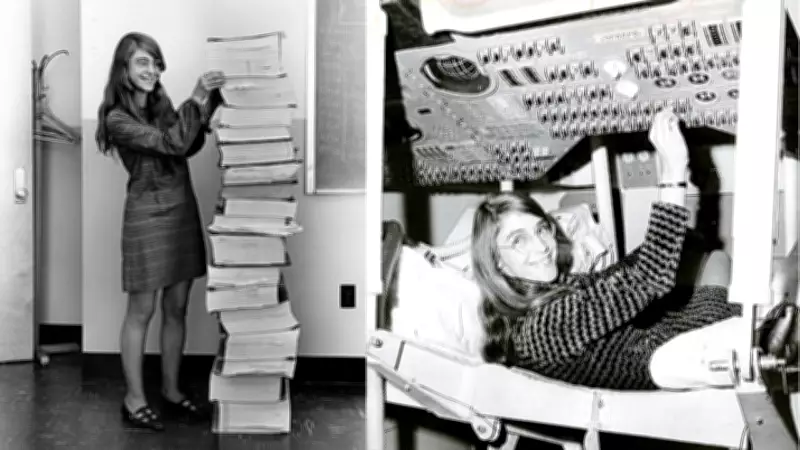
The iconic photograph of Margaret Hamilton, standing proudly beside a towering stack of Apollo code printouts, is more than just a historic image. It symbolizes the human spirit, precision, and ingenuity that propelled one of humanity's greatest achievements. Indeed, the code developed by Hamilton and her team was instrumental in the safe landing of astronauts on the Moon in 1969, marking a monumental milestone in space exploration.
Revolutionizing Software Engineering for Apollo Missions
Margaret Hamilton supervised the Software Engineering Division at MIT, where she led the design of flight software for NASA's Apollo missions. As NASA notes, her work was revolutionary not only for enabling the Moon landing but also for popularizing the term software engineering itself. The famous 1969 photo captures her next to printouts of code for the Command Module and Lunar Module, highlighting the meticulous effort behind the mission.
This code was crafted to handle potential errors during spaceflight. For instance, during Apollo 11's descent, when the computer overloaded, the software prioritized critical tasks, allowing the mission to proceed safely. Hamilton emphasized the high stakes, stating, "There was no second chance. We knew that." Her approach established software as a mission-critical system, not just an auxiliary tool.

From Apollo to Artemis II: Advancing Lunar Exploration
Fast forward to 2026, and NASA is preparing for the Artemis II mission, set to send four astronauts on a ten-day flyby of the Moon—the first human lunar mission since Apollo 17. While Artemis II leverages far more advanced computing technology than Apollo's 72 kilobytes of memory, its core objective remains similar: testing technology for deeper space exploration.
A key historic aspect of Artemis II is its crew, which includes the first woman and first person of color to travel beyond low Earth orbit, reflecting social evolution in space travel. The mission builds on decades of innovation, with Hamilton's legacy evident in its software design principles.
Software Engineering Legacy in Modern Space Missions
Hamilton's methodology of creating systems that identify, prioritize, and overcome errors continues to shape NASA's engineering practices. She famously told TIME magazine after Apollo 11, "It worked," underscoring the trust in software reliability. Today's spacecraft, equipped with diagnostic systems, real-time communication, and navigation tools, still adhere to this premise: software must perform flawlessly under extreme conditions.
The evolution from Hamilton's handwritten code listings to Artemis II's sophisticated technology tells a story of human ingenuity and iterative innovation. As Artemis II orbits the Moon, it not only tests cutting-edge tech but also honors pioneers like Hamilton, whose foresight and courage laid the groundwork for success.
Conclusion: A Continuation of Human Ingenuity
Artemis II represents more than a return to the Moon; it is a continuation of the legacy started by Margaret Hamilton. Her work demonstrates that behind every space mission, it is the lines of code—written with vision and resilience—that drive progress. In the vastness of space, human ingenuity remains the ultimate force, as Hamilton's story continues to inspire future explorations.