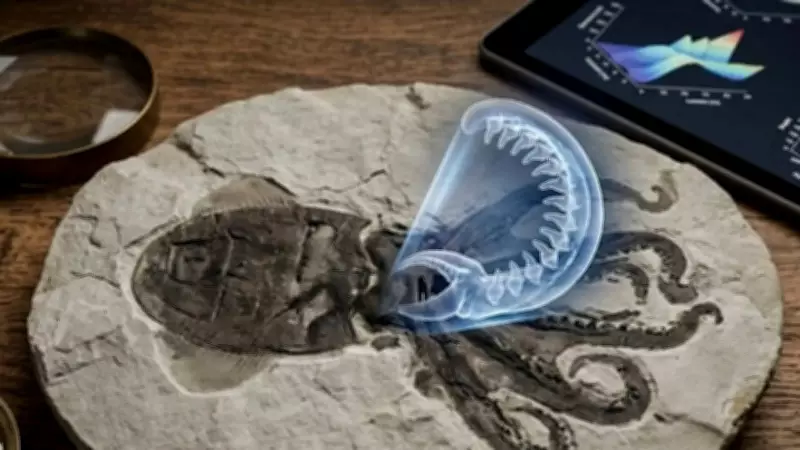
Decades-Long Fossil Misidentification Corrected by Advanced Technology
For more than twenty years, the 300-million-year-old fossil known as Pohlsepia mazonensis was celebrated globally as the world's oldest known ancestor of modern octopuses. Its soft, sack-like appearance led paleontologists to classify it as a primitive soft-bodied cephalopod, a landmark discovery in understanding octopus evolution. However, a groundbreaking twenty-year study utilizing cutting-edge synchrotron X-ray imaging has completely overturned this long-held classification.
The Critical Discovery That Changed Everything
The fossil, discovered in Mazon Creek, Illinois, had perplexed researchers because it lacked the outer shell or hard body structures typically associated with nautiloids. Initial interpretations suggested it represented an ancient soft-bodied invertebrate, an early form of octopus. The recent high-resolution scans, however, provided revolutionary insight. Scientists determined that what was previously interpreted as an 'octopus' shape was actually the result of taphonomic decay and immense geological pressure during fossilization.
This process entombed the organism in a deceptive morphology, causing the complete disintegration of its original aragonite shell. Digital decompression techniques applied to the surrounding rock matrix revealed that the animal's true anatomy bore no resemblance to the external octopus-like form observed for decades.

Why Pohlsepia is Officially a Nautiloid
The pivotal turning point in this research came with the use of a particle accelerator called a synchrotron. This technology produced an intense beam of light that allowed scientists to see through the solid rock and map the chemical signatures of the organism's internal structures. The analysis identified a radula—a specialized, toothy feeding organ found in molluscs.
The radula of Pohlsepia mazonensis was found to have nine teeth in a single row, a configuration that does not correspond to any known octopus species but matches the dental patterns of nautiloids perfectly. This definitive evidence confirmed that the fossil possesses the rigid feeding apparatus characteristic of shelled nautiloids, not the soft anatomy of octopuses. Consequently, Pohlsepia has been officially reclassified, placing it on a different branch of the cephalopod family tree.
Implications for Octopus Evolutionary History
This reclassification carries profound implications for our understanding of cephalopod evolution. With evidence now demonstrating that Pohlsepia preserves key elements of nautiloid anatomy, it eliminates the last known oldest organism directly linked to the octopod lineage. According to analyses referenced from institutions like the Natural History Museum, this creates an enormous new gap in the fossil record for octopuses.
This finding suggests that octopuses may have developed their distinctive soft-bodied characteristics much more recently than the previously assumed 300 million years ago. The study serves as a powerful cautionary tale about the dangers of relying solely on external morphology when interpreting fossils. It highlights how modern technological advancements can rectify decades of scientific inaccuracy by revealing internal structures invisible to the naked eye.
Furthermore, the reclassification of Pohlsepia will compel scientists to reconsider the timeline for when cephalopods lost their shells. This reassessment is crucial for understanding how these creatures evolved into the agile, fast-moving predators that dominate ocean ecosystems today. The research underscores the dynamic nature of paleontology and the continuous refinement of evolutionary narratives through technological innovation.