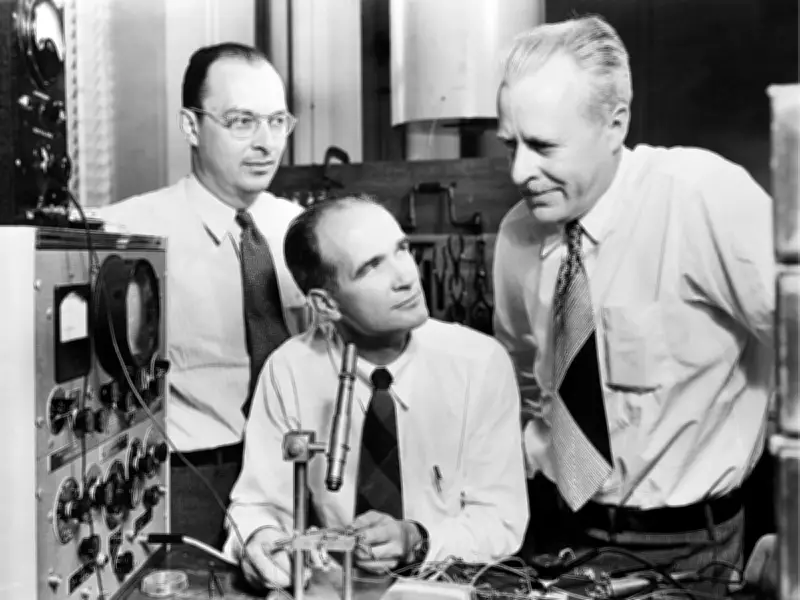
In December 1947, inside a laboratory at Bell Telephone Laboratories in New Jersey, two physicists were investigating a question that had perplexed researchers for years: could a solid material control electrical signals as efficiently as the bulky vacuum tubes of the time?
The experiment looked deceptively simple. John Bardeen and Walter Brattain placed two tiny gold contacts on the surface of a pure germanium crystal and measured how electricity moved through it. What they observed was astonishing. A weak signal going into the device came out as an amplified one.
The amplification effect showed that the device was the first functioning transistor. Yet the science behind it wasn't simply about making a new gadget; it was a revelation about the behaviour of electrons within matter that forever changed physics and the foundation of modern electronics.

The mystery hidden inside semiconductors
By the 1940s, scientists knew a good deal about metals and insulators; electrons moved freely through the former and were blocked by the latter. Semiconductors occupied an intriguing middle ground.
The germanium that was used to make the first transistor fell into this category. Under certain conditions, it would conduct electricity, but its behaviour was far more complex than that of ordinary metals.
As discussed in a historical review published in Nature, decades of purification of semiconductor materials and the development of crystal rectifiers gradually revealed that carefully manufactured materials like germanium could be coaxed into precise electrical behaviours. The transistor emerged from this growing understanding rather than any single eureka moment.
Researchers realised that small impurities within a crystal could have enormous effects on electron flow. The trick, it turned out, was learning how to manipulate those effects rather than trying to eradicate them completely.
Why Germanium became the breakthrough material
The selection of germanium as the material for the transistor was no accident. Semiconductor experiments required exceptionally pure crystals because uncontrolled impurities could dramatically alter electrical behaviour. The Bell Labs scientists spent years trying to purify germanium crystals, as even the smallest contaminants interfered with their experiments.
According to Nature, advances in purification techniques allowed researchers to create semiconductor samples with properties stable enough to study systematically. This provided a foundation for theories concerning electron transport and conductivity.
What made germanium especially valuable was that it was quite sensitive to small external changes in electric charge. Those impurities could produce effects within the crystal itself, and studying them eventually led to the discovery of surface states, which are crucial for semiconductor devices.
The experiment that unveiled the ability to control electron flow
The famous December 1947 experiment was designed to explore the effect of charges on the surface of germanium.
Bardeen had put forward the theory that electrons trapped on the surface of a germanium crystal might be the reason why previous semiconductor devices had not performed as predicted. Working together with Brattain, the physicists steadily improved their experimental apparatus to test this hypothesis. When the two gold contacts touched the crystal surface, one injected charge carriers into the material, and the other detected the resultant changes in current flow. Bardeen and Brattain discovered that a small electrical signal entering the germanium could affect a much larger current flowing through the crystal.
The result demonstrated amplification, one of the most important functions in electronics.
The point-contact transistor could perform many of the functions that had previously required vacuum tubes, albeit by using entirely different physical principles.
A triumph of physics, not just engineering
Though often lauded as an engineering achievement, many historians of science consider the transistor to be an equally profound triumph of condensed matter physics. Bell Labs is often cited as one of the 20th century’s most influential institutions because it brought physicists, chemists, materials scientists and engineers together under one roof.

The interdisciplinary nature of their work was critical, as the transistor required knowledge of quantum mechanics, crystal structures, electrical conduction, and materials purification. The invention would not have been possible without advancements in fundamental physics.
The research also helped establish semiconductor physics as one of the major scientific fields of the post-war era. Scientists went on to discover how electrons behave in more and more complex materials, and their findings went far beyond the scope of telecommunications.
How a single physics experiment changed our understanding of matter
Beyond the sheer practicality of its functions, the transistor has also provided physics with new avenues for exploration. It demonstrated that electrons in solids can be controlled with amazing accuracy. This opened up vast new research fields, not just in semiconductor devices but in quantum materials, among other things.
According to a peer-reviewed review in Materials, available through PubMed, the principles behind the first transistor paved the way for the development of other types of semiconductor devices, such as MOSFETs, which have been foundational for modern integrated circuits.
Though there were still many advances to be made between the germanium crystal of 1947 and the billions of transistors we see in modern chips, the core concept remained the same: precisely manipulating the movement of electrons within engineered materials.
The signal that launched a scientific revolution
Reflecting on its beginnings, the first transistor involved nothing more than a small chunk of germanium, two gold contacts, and a precisely measured electrical signal.
However, the experiment yielded something profound, demonstrating that electron flow in solids could be controlled and amplified with stunning accuracy. It gave us more than just a replacement for the vacuum tube; it gave us a new way of looking at the world.
The signal that strengthened beneath two gold contacts marked the start of a scientific revolution that still shapes research labs, computer systems and communication networks nearly eight decades later.