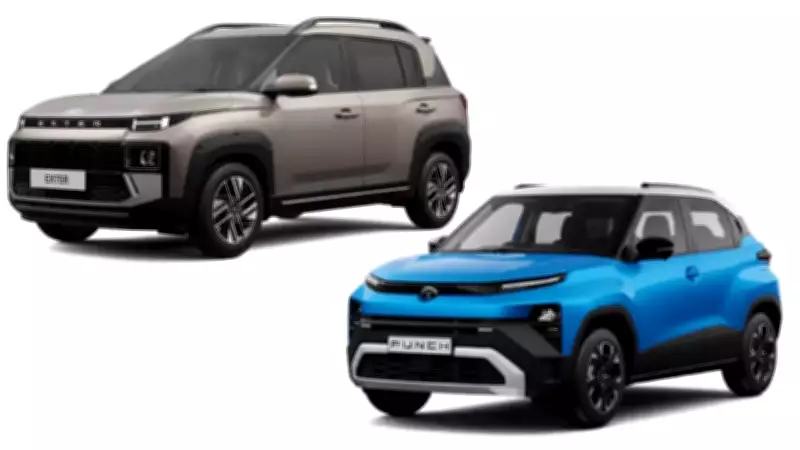
Hyundai Exter Facelift vs Tata Punch Facelift: A Head-to-Head Showdown
The micro-SUV segment in India is witnessing intense competition, with two major players recently unveiling significant updates. Hyundai has launched the refreshed Exter Facelift, directly challenging the updated Tata Punch Facelift. While the Tata Punch has traditionally dominated this space, both models now feature notable enhancements, making this comparison particularly timely and relevant for potential buyers.
Dimensions and Exterior Design
Starting with the physical measurements, the Hyundai Exter Facelift measures 3,830 mm in length, 1,723 mm in width, and 1,643 mm in height. It boasts a wheelbase of 2,450 mm and offers a generous boot capacity of 391 litres. This configuration provides ample vertical space and luggage room, appealing to families and those requiring extra storage.
In contrast, the Tata Punch Facelift is slightly longer at 3,876 mm and wider at 1,742 mm, but stands lower at 1,615 mm. Its wheelbase is marginally shorter at 2,445 mm, with boot space measuring 366 litres. The Punch's design emphasizes a wider stance, which may enhance stability and road presence. Essentially, the Exter focuses on height and cargo capacity, while the Punch prioritizes width and length.

Interior Features and Technology
Both SUVs showcase clear interior upgrades that enhance comfort and convenience. The Hyundai Exter Facelift introduces a fresh dual-tone navy blue and grey theme, complemented by semi-fabric beige seat upholstery and a new flat-bottom steering wheel. Key features include an 8.0-inch touchscreen infotainment system, an 8.0-inch digital driver's display, cruise control, wireless charging, a sunroof, automatic climate control, and an integrated dashcam. However, it notably lacks a 360-degree camera, which might be a drawback for some drivers.
The Tata Punch Facelift, on the other hand, comes equipped with a larger 10.2-inch touchscreen, wireless Android Auto and Apple CarPlay, a 7-inch digital instrument cluster, touch-based climate controls, rear AC vents, ambient lighting, connected car technology, and an auto-dimming IRVM. A standout feature is the inclusion of a 360-degree camera setup, which enhances parking and maneuvering safety. These additions position the Punch as a tech-forward option in the segment.
Engine Specifications and Performance
The Tata Punch Facelift offers multiple powertrain options to cater to diverse preferences. These include a 1.2-litre naturally aspirated petrol engine, a new 1.2-litre turbo-petrol engine, and a CNG variant. The turbocharged unit is particularly noteworthy, producing 118 horsepower and 170 Nm of torque, making it a unique offering in this segment. The naturally aspirated version delivers 88 hp and 115 Nm, while the CNG variant offers 73.5 hp and 103 Nm. Transmission choices encompass manual and AMT options, though the turbo-petrol engine is limited to a 6-speed manual gearbox.
In comparison, the Hyundai Exter Facelift maintains a simpler approach. It is powered by a 1.2-litre four-cylinder petrol engine that generates 83 horsepower and 114 Nm of torque, available with both manual and AMT transmissions. The CNG version develops 69 hp and 95 Nm and is offered exclusively with a manual transmission. Both models incorporate dual-cylinder technology for their CNG variants, ensuring efficiency and reliability.
Pricing and Market Positioning
When it comes to pricing, the Tata Punch Facelift is positioned between Rs 5.59 lakh and Rs 9.29 lakh, ex-showroom. The Hyundai Exter Facelift ranges from Rs 5.80 lakh to Rs 9.42 lakh, ex-showroom. This slight price difference reflects the competitive nature of the market, with each model offering distinct advantages. The Punch's lower starting price might attract budget-conscious buyers, while the Exter's higher-end variants could appeal to those seeking premium features.

In summary, the Hyundai Exter Facelift and Tata Punch Facelift present compelling options in India's micro-SUV segment. The Exter excels in vertical space and boot capacity, while the Punch offers a wider stance and advanced technology like the 360-degree camera. Engine choices vary, with the Punch providing more diversity, including a turbo-petrol option. Pricing is closely matched, making the decision dependent on individual priorities such as design, features, and performance needs.