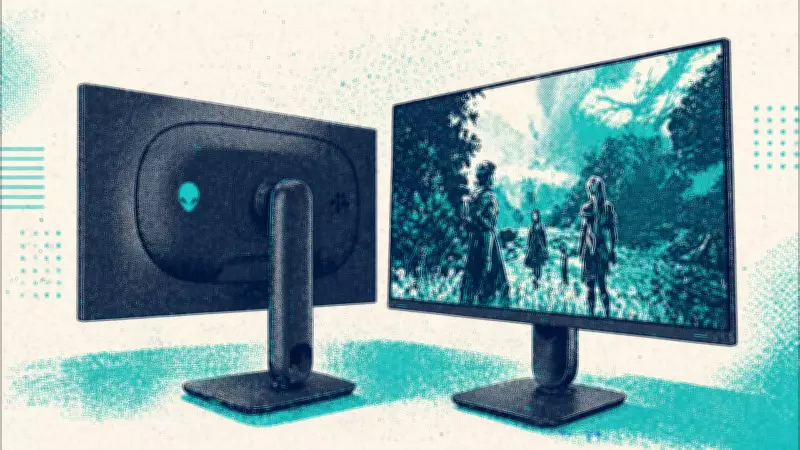
The 4K resolution at 27 inches has always been a topic of debate. Some argued it was too dense, wasted on a screen this small, and better suited to 32 inches where pixels have room to breathe. For years, the maths backed that up. The available 27-inch 4K panels were LCDs, while OLEDs were locked at 1440p with visible text fringing.
That changed this year. A new 27-inch 4K QD-OLED panel arrived running at 240Hz, offering the highest pixel density ever seen on a desktop OLED. Three brands have built monitors around it. The Alienware AW2725Q is the one that takes the category mainstream, partly due to what's inside the chassis and partly due to its cost. It is the first 27-inch 4K QD-OLED to land in India at a price that doesn't dare you to spend more. The experience of using it makes the 32-inch alternative feel like a different decision rather than an obviously better one.
Whether it's the right monitor for you depends on a handful of details. Here they are.

Sharper, Finally
Day one with the AW2725Q is the unboxing-and-cabling kind of day. Day two is when it starts to register. Same desk, same chair, same workflow—sharper everything. The jump from a 27-inch 1440p panel is immediate. With the same screen size and fifty percent more pixels per inch, code editors get tighter, and long-form text on a webpage stops asking you to lean forward. The Windows desktop reads correctly in the way it does on a 4K LCD, something OLED hadn't quite managed at this size before. Older 27-inch OLEDs came with a tax on text—colour fringing on small fonts, softness around UI edges, the kind of artefacts that sent you back to an IPS panel for work.
That tax is gone here. At normal viewing distance, the screen reads like a good LCD. There is a parallel argument for 32-inch 4K OLEDs, and it isn't wrong. A 32-inch screen is more cinematic and pulls you into a game like Cyberpunk or Veilguard better. But the maths flips when you sit closer than three feet from your monitor, which most people do at a desk. At that distance, a 32-inch screen starts asking your neck to do work. The 27-inch is the size your eyes were already at peace with. Now it's just much sharper.
Colour coverage is what you'd expect from this panel: 99% of DCI-P3, full sRGB, and average Delta E values under one in the default profile. Out-of-the-box accuracy is close enough to calibrated that most people won't bother going further. If you do creative work and need an sRGB clamp, there's one in the OSD. Windows 11's Auto Color Management does a slightly better job for SDR content if you'd rather not touch the menu.
What Contrast Actually Buys You
This is where the AW2725Q earns the price of admission. In a dim room with a HDR scene that knows what to do with itself, the panel does something LCDs simply cannot. Black is black, highlights pierce, and the contrast between them has actual depth. There's a moment early in Alan Wake II in a cabin lit by a single lamp. On an LCD, it's atmospheric. On the AW2725Q, it's a different kind of image—the lamp burns, the corners of the room disappear, and the part of your brain that knows it's a screen briefly forgets. That's the OLED tax paying you back. Peak brightness in small highlights pushes close to 1,000 nits. Sustained highlight performance is meaningfully better than older OLEDs.
Dolby Vision is supported, which is rare on monitors and useful if streaming and gaming share the same screen. The PQ EOTF tracking isn't the most accurate of the current QD-OLEDs; mid-tones run a touch brighter than the target. The impact on actual viewing is small enough to ignore in motion. There is an eARC HDMI port for routing audio out to a Dolby Atmos soundbar. No speakers, no headphone jack. That's the audio plan if you're not on USB headphones.
Fast, With a Footnote
The 240Hz refresh rate paired with OLED's 0.03ms response time gives you motion clarity that ruins slower screens for you. No ghosting. Counter-Strike 2 and Marvel Rivals feel snappy in a way that has more to do with how clearly your eyes can track moving objects than with raw input lag, though input lag is also very low across all refresh rates.

There is one wrinkle. With G-Sync or FreeSync enabled, the monitor shows VRR flicker when frame rates fluctuate. It is a known characteristic of QD-OLED panels in dark scenes when the GPU bounces between, say, 80 and 130fps. Most of the time it isn't distracting. If you're sensitive to it, you'll notice. A couple of firmware updates have improved overall stability, but the flicker remains a panel-level quirk.
You'll need a serious graphics card to actually push this thing. 4K at 240Hz isn't a free lunch, even on the latest hardware. Frame generation does most of the heavy lifting in modern titles, and the AW2725Q is the kind of monitor that makes you a DLSS multi-frame gen convert pretty quickly. The visual benefit of 200fps over 80fps is real. Frame gen is the cheapest way to get there without rebuilding your rig around the monitor.
The Chassis Around It
Alienware calls the colour Interstellar Indigo. It's a deep navy that reads as black-with-blue-undertones in most light and indigo when something hits it directly. More interesting than another slab of matte plastic, and it works. The new AW30 design language is rounder than older Alienware monitors, with soft contours where there used to be hard angles. Whether this lands depends on what's around it. Next to a black desktop, it stands out. Next to an eclectic setup, it disappears.
The stand is small-footprint with a flat top, so you can park a notebook or a coffee mug on it without issue. Tilt, swivel, height, and pivot adjustments are all there, with 90-degree pivot in either direction if you ever need vertical orientation. Cable routing through the stand is one of the cleaner implementations at this price. Plug everything in and the back of your desk looks like a marketing photo.
There is a fan inside, because QD-OLED panels need active cooling. It runs quiet enough through normal use that I never noticed it. Dell has built the power supply into the monitor too, which means no proprietary brick to lose and one fewer cable to manage. In SDR, peak brightness sits at around 250 nits—typical for OLED, adequate for most desks. The QD-OLED coating responds to ambient light differently from a glossy WOLED, with blacks lifting slightly when light hits the screen directly. This is a panel characteristic, not a flaw, and it stops mattering the moment you stop fighting the room.
Where the Savings Come From
The AW2725Q is meaningfully cheaper than other monitors using this same panel. The savings have to come from somewhere, and most of them show up in connectivity. You get DisplayPort 1.4 instead of 2.1. In practice, this means the monitor relies on Display Stream Compression to hit 4K at 240Hz. It is visually lossless and won't trouble most people, but it is technically a step behind. The USB-C port delivers only 15W of power and doesn't carry video. You can charge a phone off it, but you can't charge a laptop. You can't use it as a one-cable docking solution. There is no KVM switch either, so if you swap between a desktop and a laptop with shared peripherals, you'll be unplugging cables.
For a single-PC gaming rig, none of this matters. For someone splitting use between a work laptop and a gaming desktop, the cuts stack up. Decide which camp you're in before the spec sheet decides for you.
The Longevity Question
Burn-in is the question every potential OLED buyer asks, and the answer hasn't really changed. Take the standard precautions, run the panel refresh when prompted, hide the Windows taskbar in fullscreen apps, and the screen will be fine for years. Dell offers a three-year warranty in India that covers burn-in, which is the right insurance for a monitor at this price.
The pixel-refresh routine kicks in after every few hours of use, takes about five minutes, and runs while the monitor is in standby. Dell uses a graphite film behind the panel as a heatsink, paired with the active cooling, to keep temperatures down. You'll get a panel-health prompt occasionally asking you to run a refresh. Skip it long enough and the firmware will dim parts of the picture, like the Windows taskbar, to protect the panel until you let it run.
So Who Is This For?
Rs 85,499 is what Dell asks for this monitor. Whether it is worth paying comes down to two questions: what you'll do with the monitor, and what you'll do without the things Dell didn't include. If you are building or upgrading a single gaming PC, have a graphics card that can push 4K at high frame rates, and don't need USB-C docking or a KVM, this is the monitor. The picture you get is the picture you'd get from more expensive options using this panel, minus connectivity features many people will never touch. If you split your time between a laptop and a desktop and want the monitor to be your dock, pay more for one with proper USB-C. If immersion matters more to you than pixel density, the 32-inch version of this panel exists.
For everyone else, the AW2725Q is what a 4K OLED gaming monitor should cost. The 27-inch 4K argument that has been running for years finally gets a screen that ends it. The screen does what you'd expect from this category. The price does not.
Our rating: 4/5