PM Modi Inaugurates Noida Semiconductor Facility, Highlights Chip Manufacturing as National Priority
Prime Minister Narendra Modi on Saturday framed India's ambitious push into semiconductor manufacturing as absolutely central to building a self-reliant nation, declaring that the country's comprehensive development critically depends on producing essential chips domestically and establishing a trusted supply chain for the entire world.
"A developed India can only be achieved when the country becomes truly self-reliant. For that monumental goal, it is extremely important that chips are made right here in India," the Prime Minister stated emphatically during his virtual address.
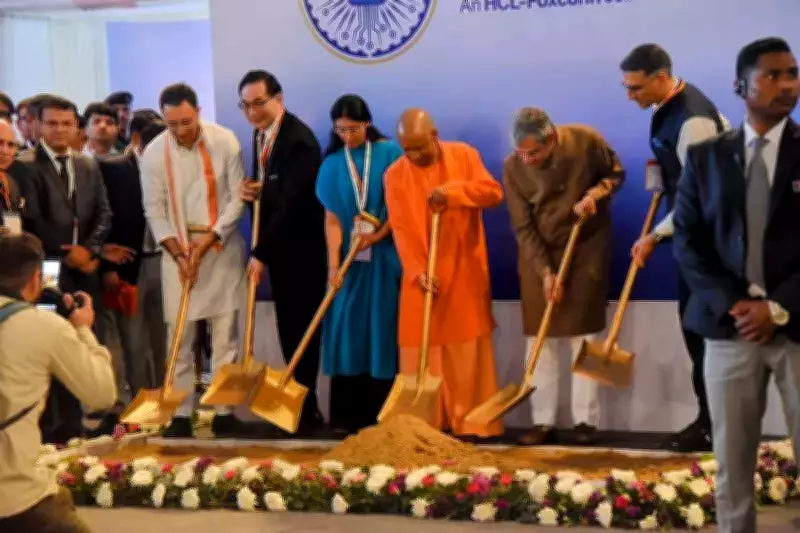
Foundation Stone Laid for Major Joint Venture Facility
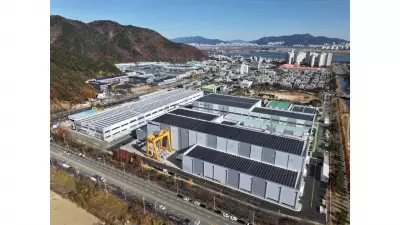
The Prime Minister made these pivotal remarks while virtually laying the foundation stone for India Chip Private Limited, a significant joint venture between the HCL Group and Foxconn. This venture will establish an outsourced semiconductor assembly and test facility, known as an OSAT unit, located in Sector 28 of the Yamuna Expressway Industrial Development Authority region in Noida.

This advanced high-technology facility, planned with a substantial investment of approximately Rs 3,700 crore, is projected to become fully operational by the year 2028. It is specifically designed to manufacture display driver integrated circuits, which are crucial components for electronic displays, with a planned capacity to process an impressive 20,000 wafers every single month.
The landmark project is expected to generate more than 3,500 direct employment opportunities, while also significantly spurring the growth of local supply chains and numerous ancillary industries in the surrounding region.
High-Profile Attendance and Strategic Importance
The event witnessed the presence of Uttar Pradesh Chief Minister Yogi Adityanath and Union Minister for Railways, Information and Broadcasting, and Electronics & IT, Ashwini Vaishnaw. Key industry leaders present included HCL Group Chairperson Roshni Nadar Malhotra and Young Liu, the Chairman of Hon Hai Technology Group, widely known as Foxconn.
In his detailed address, Prime Minister Modi described semiconductors as the indispensable backbone of the modern digital economy, intricately linking them to everyday services and vital strategic sectors.
"Whether it is the Digital India initiative, advancements in artificial intelligence, the rollout of 5G and future 6G networks, the proliferation of electric vehicles, sophisticated medical devices, or advanced defence equipment — semiconductors are absolutely essential components in every single one of them," he explained. "Without these tiny chips, modern life as we know it would come to a complete standstill."
Geopolitical Significance and Supply Chain Resilience
The Prime Minister also drew a broader geopolitical and historical comparison to underline precisely why indigenous chip manufacturing capability matters so profoundly for national power and prosperity.
"In the 20th century, nations that possessed and controlled oil reserves gained immense prosperity and wielded significant global power. In the 21st century, that same transformative power lies in these small silicon chips and in the advanced skills and materials associated with their production. Chips are, without a doubt, the digital diamonds of the modern era," he proclaimed.
Pointing directly to recent global disruptions, Modi noted that the COVID-19 pandemic starkly exposed how vulnerable international chip supply chains truly were.
"We all witnessed firsthand how fragile the global chip supply chain had become. When severe disruptions occurred, factories and production lines across the world came to an abrupt halt, automobile manufacturing slowed dramatically, and electronics production was severely affected," he recounted, adding that India had chosen to treat this global crisis as a strategic opening. "We resolved decisively to make India self-reliant in chip manufacturing and to proactively build a trusted and resilient semiconductor supply chain for the entire world."

Catalyst for Broader Technology Ecosystem
According to the Prime Minister, the new Noida semiconductor unit could act as a powerful anchor for developing a much wider technology and innovation cluster in Uttar Pradesh.
"Wherever a major semiconductor manufacturing unit is successfully established, specialized design houses naturally follow, advanced research and development centres are set up, skill development institutions come up, and a vibrant start-up ecosystem develops organically. All of this transformative development is now decisively going to happen right here in Uttar Pradesh," he stated with confidence.
He further emphasized that India was now systematically building formidable hardware manufacturing capacity to complement its globally recognized software strengths.
"India is renowned globally for its exceptional software prowess and IT services. Now, we are decisively adding large-scale hardware manufacturing at an unprecedented scale. We are moving ahead with remarkable speed and unwavering confidence under the visionary framework of the India Semiconductor Mission," the Prime Minister affirmed.
Focus on Talent Development and Complete Ecosystem
The Prime Minister also highlighted the government's parallel work on developing deep talent pools and advancing technology capabilities across the entire semiconductor value chain.
"We are actively preparing industry-ready professionals through specialized programs… we are expanding robust support for advanced packaging technologies and cutting-edge research and development… we are meticulously creating a complete end-to-end support system — spanning from initial chip design to sophisticated fabrication, and all the way through to final assembly, testing, and packaging," he detailed.
State Leadership and Industry Perspectives
Chief Minister Yogi Adityanath hailed the project as a definitive turning point for the state's industrial ambitions and technological future.
"This is Uttar Pradesh's very first display driver semiconductor assembly and test unit. Under the Prime Minister's dynamic leadership, the Jewar region has been transformed, and a glorious new chapter in high-technology manufacturing is being written here today," the Chief Minister said.
Adityanath added that comprehensive governance reforms and massive infrastructure development were helping attract unprecedented levels of investment.
"Through unwavering transparency, trust-based governance, and bold regulatory reforms, Uttar Pradesh is being firmly established as a premier dream destination for global and domestic investors across sectors," he stated.
HCL Group Chairperson Roshni Nadar Malhotra noted that the new unit significantly extends HCL's established technology and manufacturing footprint within the state.
"We are profoundly grateful to the Government of India and the Government of Uttar Pradesh for their unwavering and steadfast support in making this visionary project a reality," she added.
For Foxconn's Young Liu, the joint venture perfectly aligns with the company's strategic localization approach within India.
"This landmark joint venture is a stellar example of how we build, operate, and localize our advanced manufacturing capabilities within India. We are deeply thankful to our esteemed partner HCL and feel immensely privileged to be recognized by the governments of India and Uttar Pradesh for achieving this significant milestone," Liu remarked.
Project Scale and Regional Impact
Shailendra Bhatia, Additional CEO at YEIDA, confirmed that the unit would become the largest such semiconductor manufacturing hub in the entire northern region of India. The extensive facility will be constructed on a 48-acre site that was formally allotted for this purpose in January of this very year, marking a rapid progression from planning to execution.
The inauguration of this semiconductor plant underscores a major stride in India's strategic journey towards technological self-sufficiency, positioning the nation as an emerging and reliable player in the critical global semiconductor industry, which forms the foundation of the modern digital world.