Namo Bharat RRTS Revolutionizes NCR Commuting, Unlocking New Lifestyles
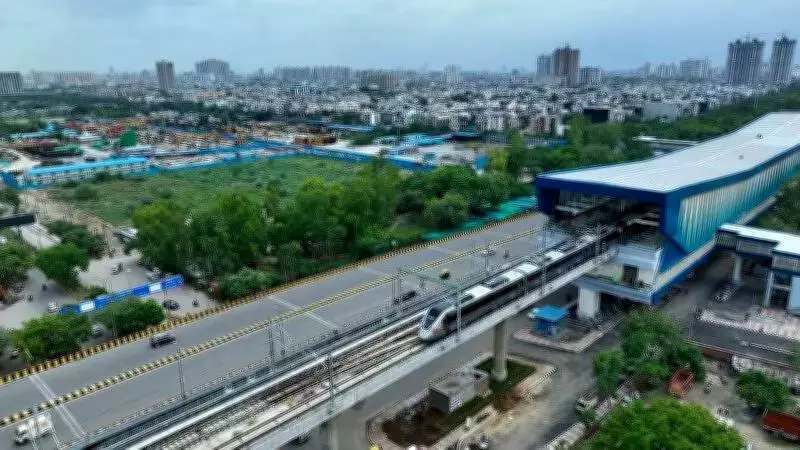
When Parag Agarwal decided to relocate from his rented apartment in Vaishali last year, it wasn't due to a job change or a significant life event. The catalyst was a train—specifically, the Namo Bharat Rapid Rail Transit System (RRTS), which now connects Meerut to Ghaziabad in just half an hour. Since its initial launch in October 2023, the phased opening of the 82-kilometer Delhi-Meerut corridor has fundamentally reshaped the National Capital Region's map, making it feasible for residents to maintain their homes in Meerut or farther towns like Ghaziabad while pursuing dynamic careers in Delhi and Noida.
Seamless Integration and Enhanced Mobility
With the full corridor set to open on Sunday, this integration will accelerate for countless more commuters. A ride on the RRTS from Meerut to Sarai Kale Khan will now take approximately the same time as a Yellow Line metro journey between Gurgaon and Connaught Place or a Blue Line trip from Dwarka to Mayur Vihar. Parag Agarwal, who operates a digital marketing firm, has fully embraced Meerut as his permanent base. "My wife's office is in Sahibabad, so we initially rented a flat in Vaishali to be closer to her workplace. However, last year, we moved back to Meerut after the RRTS reduced travel time between Meerut and Ghaziabad to about 30 minutes," he explained.
The family has also abandoned plans to purchase a house in Ghaziabad or Noida. "For working professionals, living near the national capital often feels essential, but everything there was beyond our budget, so we shelved the idea. When the rapid rail reached Meerut South in August last year, we began searching for property there and found an affordable flat. Now, my wife commutes to Ghaziabad via RRTS, and I can meet clients in Delhi and still return home by evening. Life has become significantly more manageable," Agarwal added.

Cost-Effective and Convenient Travel Options
Nitika Rastogi from Modinagar highlighted that the rapid rail is far more economical and convenient than cab services. A one-way journey to New Ashok Nagar costs Rs 180 in the premium coach and Rs 120 in the standard one. "The first time I traveled from Modinagar to Delhi, I was astonished by the speed. We typically take a cab, which can cost anywhere between Rs 750 and Rs 1,200," she noted.
Colleagues Amit Nagar and Sonia Tomar, who work in Noida Film City, reported that the RRTS has transformed their daily commutes. Amit travels from Govindpuram, and Sonia from Raj Nagar Extension, both utilizing the rapid rail between New Ashok Nagar and Guldhar. "The Ghaziabad-Noida Film City stretch is infamous for bottlenecks. Driving during peak hours can be exhausting due to frequent traffic jams. Now, travel time has decreased to about half an hour from over 45 minutes," Amit stated.
Beyond Work: Enhancing Social and Family Life
The benefits extend beyond professional needs, with many using the service for weekend plans. Kiran, a resident of Shatabdi Vihar in Meerut, now frequently travels to Delhi on weekend mornings to visit her daughter. "I take the first rapid rail from Meerut South and reach New Ashok Nagar in approximately 40 minutes. My daughter, a nurse, finishes her night shift around then, so we can spend the day together. If I don't wish to stay overnight, I can easily return home by evening," she shared.
The complete corridor, featuring 22 stations, will reduce travel time between Meerut and Delhi to roughly 55 minutes. The initial 17-kilometer section from Sahibabad to Duhai Depot opened on October 20, 2023. Subsequent phases included Duhai to Modinagar (North) on March 6, 2024, Modinagar North to Meerut (South) on August 18, 2024, and Sahibabad to New Ashok Nagar on January 5, 2025. The final segment between Meerut South and Modipuram depot stations in Meerut and Sarai Kale Khan station in Delhi will become operational on February 22.

Empowering Entrepreneurs and Students
For Sandeep Anand, who manages a restaurant in Delhi's Chandni Chowk, the RRTS has made a challenging decision—staying in Meerut to care for his elderly parents or traveling on weekends—more feasible. "My life has become convenient now. I sit in the air-conditioned trains and travel from Meerut to Anand Vihar. From there, I take the Delhi Metro to Chandni Chowk. Previously, my only option was to travel by bus from Meerut," Anand remarked.
Entrepreneurs are also leveraging the train to overcome distances that previously hindered business operations. Akshay Chari, a Mayur Vihar resident, runs a polyfarm in Meerut and visits weekly for supervision. "The ride is 30 minutes, plus an additional 5-minute walk from New Ashok Nagar station to my home. Earlier, I could only go there once every 15 days, which demotivated workers and slowed progress. Now, with the RRTS, I can reach there in about 40 minutes during any crisis," Chari explained.
Sugandh Kumar from Meerut's Begumpur noted that the train has helped maintain a healthier balance between study and social life. "As I prepare for competitive exams, I cannot waste excessive time on leisure, and traveling for two hours just to meet friends was impractical. Now, it only takes 40 minutes to reach Anand Vihar," Kumar said.
Students commuting to colleges in Delhi and other NCR cities from Meerut have also benefited. Class 11 students Saumya Dahiya and Devansh Singh from Modinagar take the RRTS daily after school to attend a coaching class in Anand Vihar. "The coaching faculty in Modinagar is not on par with that in Delhi. For better preparation, we enrolled in the Anand Vihar center because commuting is no longer a hassle," Saumya stated.
Somya Gupta, a student at ITS College in Mohan Nagar, emphasized that the corridor has expanded coaching and college options, allowing many to stay at home instead of opting for hostels. "Without the RRTS, I would have had to choose a hostel, as a daily two-hour bus commute one way would be impractical," she added.
Addressing Last-Mile Connectivity Challenges
Despite these advantages, gaps remain, particularly in last-mile connectivity. Shivam and Sumit Taneja, medical representatives from Delhi who occasionally travel to Meerut for work, pointed to steep transport costs after alighting. "Now, autos to Meerut city charge Rs 200 from Meerut South station. I would have preferred using my CNG car to save money," Taneja, a Yamuna Vihar resident, commented.
Shivam added, "I paid Rs 140 for a one-way fare from Anand Vihar to Meerut South. Now, I must pay another Rs 200 to enter the city. Perhaps, after the full route between Sarai Kale Khan and Modipuram becomes operational, the corridor will be more beneficial for us."