Namo Bharat Rapid Rail Achieves 82km in 40 Minutes During Pre-Launch Trial
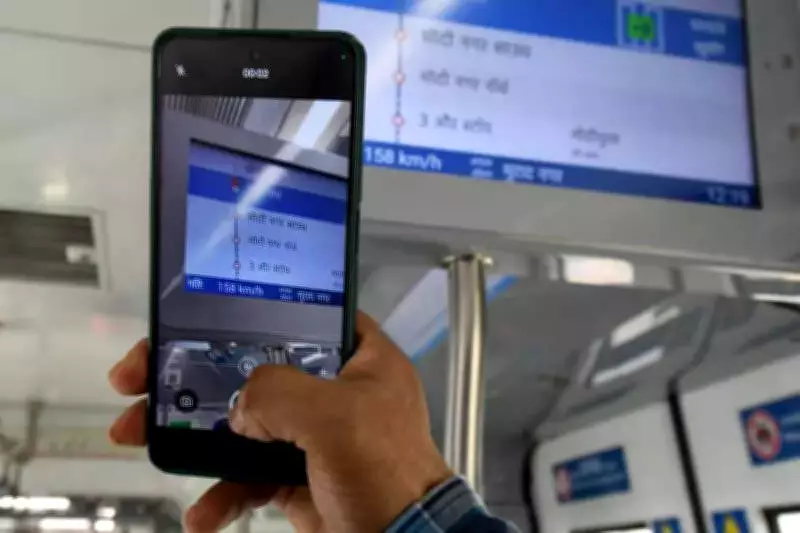
In a remarkable display of efficiency, the Namo Bharat rapid rail system completed a trial run covering 82 kilometers in just 40 minutes, reaching speeds of up to 159 kilometers per hour. This pre-launch test, conducted on Friday, occurred amidst an unusually quiet Sarai Kale Khan station in Ghaziabad, where the concourse stood silent and meticulously cleaned, guarded by security personnel and a few NCRTC officials moving with focused urgency.
Silent Stations and Swift Journeys
With the inauguration scheduled within 48 hours, the station lacked its usual bustle—no commuters, queues, or echoing announcements. At precisely noon, the train departed from the elevated station, even before the handful of passengers could settle into the spacious recliner seats of the premium coach. As footrests clicked open and screens flickered to life, the urban landscape swiftly receded below.
Traffic junctions displayed lines of stationary cars waiting for signals, while vehicles on service roads appeared sluggish in comparison. The rapid rail is designed to complete the journey from Delhi to Modipuram in under an hour, a significant improvement over the road travel time of one and a half to two hours during peak traffic.

Engineering Marvels and Scenic Views
Within four minutes, the train crossed the New Ashok Nagar station, with speed indicators oscillating between 80 and 100 kmph before steadily climbing. Soon, it glided over the Yamuna River, offering passengers fleeting aerial views of the DND Flyway and the Signature Bridge near Wazirabad. A staff member highlighted that the 1.3-kilometer bridge beneath the train is Delhi's longest over the river, marking one of several engineering achievements along the route.
Groves of kikar trees and scattered water bodies sped past as the train dipped underground near Anand Vihar at 12:10 PM. This subterranean station, where the Namo Bharat intersects with the Delhi Metro's Pink and Blue lines and the Anand Vihar railway station, caused a distinct pressure change—a mild ear pop reminiscent of an airplane takeoff. "Keep chewing," advised a fellow passenger with a grin.
Speed Peaks and Rural Transitions
Emerging from the tunnel at Sahibabad, the train surged forward, briefly touching 160 kmph between Sahibabad and Duhai. Dense clusters of buildings and shanties gradually gave way to open farmland. A calm announcement soon broke the silence: "We have reached Meerut." Industrial sheds and smoking chimneys marked the approach to Meerut South and Shatabdi Nagar.
The train then slipped underground again at Begumpul before resurfacing at Modipuram at 12:39 PM. The entire journey spanned 40 minutes and 82 kilometers without any halts, showcasing the corridor's seamless integration of elevated viaducts, deep tunnels, and massive pre-cast segments.
Project Details and Future Integration
The corridor, dressed for its formal inauguration by Prime Minister Narendra Modi on Sunday, involves a total project completion cost of Rs 30,274 crore. Currently, a 55-kilometer section across 11 stations from New Ashok Nagar to Meerut South is operational. Sarai Kale Khan station will serve as a multimodal hub, integrating with the Delhi Metro's Pink Line, Hazrat Nizamuddin railway station, Veer Haqeeqat Rai ISBT, and city bus services. It will be commissioned alongside Shatabdi Nagar, Begumpul, and Modipuram in Meerut, with the Jangpura station in Delhi to be constructed later.
An official from the National Capital Region Transport Corporation (NCRTC), which is executing the RRTS project, explained that Sarai Kale Khan will converge all three corridors—Delhi-Panipat-Karnal, Delhi-SNB-Alwar, and Delhi-Ghaziabad-Meerut—under the first phase. "This interoperability will allow passengers to travel between corridors without changing trains," the official stated.
Upon completion of the other two corridors, Delhi's mass transit system, including the Delhi Metro, will extend to 743 kilometers, surpassing the lengths of London Crossrail, Hong Kong MTR, and Paris RER, according to officials.