Census 2027 marks the 16th census since 1872 and the 8th census since Independence. Census data serves as a critical foundation for governance, informing planning processes, welfare schemes, resource allocation and the delimitation of constituencies. It provides comprehensive information on a wide range of population characteristics, including data on economic activity, literacy and education, housing and amenities, fertility, scheduled castes and scheduled tribes, language, religion, migration, as well as other socio-cultural and demographic aspects. Such data is essential for policymaking and development planning.
Digital Tools Introduced
Census 2027 will be the first to incorporate digital tools in data collection. Enumerators will gather information using mobile applications on smartphones. In addition, households will have the option to complete self-enumeration through a designated web portal — an initiative being introduced for the first time. All self-enumerated data will be subject to verification by enumerators during household visits. Enumerators will also visit households that have not completed self-enumeration to ensure full coverage.
Data to Remain Private
Though participation in the census is not mandatory, citizens are strongly encouraged to take part. The data collected is secure and protected, and cannot be used in police investigations or legal proceedings.

Conducted in Two Phases
Phase 1 (house-listing and housing census, May-June): Information is collected on housing conditions, amenities and household assets.
Phase 2 (population enumeration, Feb 2027): Information is gathered about individuals residing in the country at a specific point in time.
The first phase is underway.
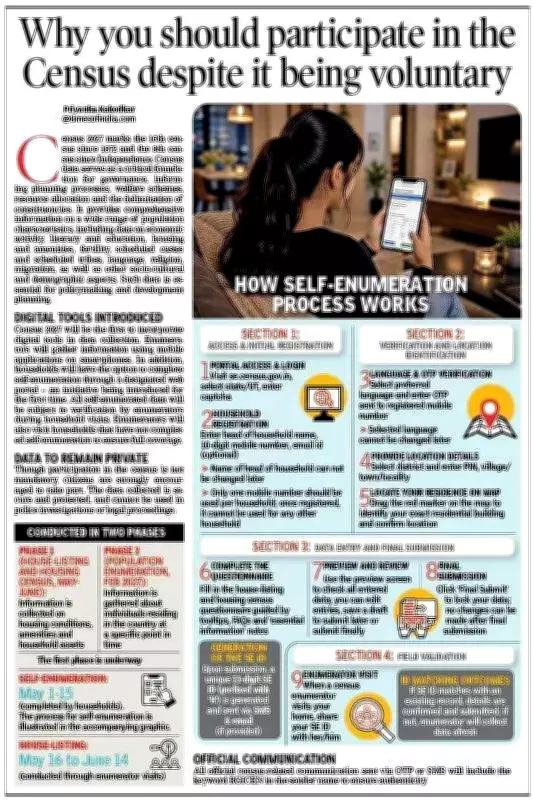
Self-enumeration: May 1-15 (completed by households). The process for self-enumeration is illustrated in the accompanying graphic.
House-listing: May 16 to June 14 (conducted through enumerator visits)
Official Communication
All official census-related communication sent via OTP or SMS will include the keyword RGICEN in the sender name to ensure authenticity.
How the Self-Enumeration Process Works
Section 1: Access and Initial Registration
- Portal access and login: Visit se.census.gov.in, select state/UT, enter captcha.
- Household registration: Enter head of household name, 10-digit mobile number, email id (optional). Name of head of household cannot be changed later. Only one mobile number should be used per household; once registered, it cannot be used for any other household.
Section 2: Verification and Location Identification
- Language and OTP verification: Select preferred language and enter OTP sent to registered mobile number. Selected language cannot be changed later.
- Provide location details: Select district and enter PIN, village/town/locality.
- Locate your residence on map: Drag the red marker on the map to identify your exact residential building and confirm location.
Section 3: Data Entry and Final Submission
- Complete the questionnaire: Fill in the house-listing and housing census questionnaire guided by tooltips, FAQs and 'essential information' notes.
- Preview and review: Use the preview screen to check all entered data; you can edit entries, save a draft to submit later or submit finally.
- Final submission: Click 'Final Submit' to lock your data; no changes can be made after final submission.
Generation of the SE ID
Upon submission, a unique 11-digit SE ID (prefixed with 'H') is generated and sent via SMS and email (if provided).

Section 4: Field Validation
- Enumerator visit: When a census enumerator visits your home, share your SE ID with her/him.
- ID matching outcomes: If SE ID matches with an existing record, details are confirmed and submitted; if not, enumerator will collect data afresh.