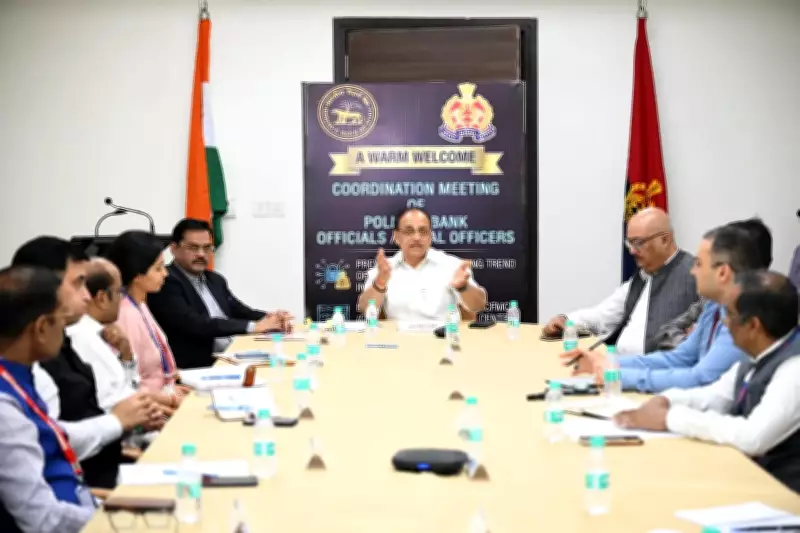
Uttar Pradesh Emerges as India's Leader in Cyber Fraud Prevention
In a significant achievement, Uttar Pradesh has been declared the top-performing state in India for preventing financial losses due to cyber fraud. Over the past eight months, authorities have successfully blocked fraudulent withdrawals worth an impressive Rs 425.7 crore through timely interventions.
Key Role of the Cyber Fraud Mitigation Centre
Officials credit this success to the Cyber Fraud Mitigation Centre (CFMC), established in July 2025. This innovative facility enables real-time coordination between police forces and banking institutions, allowing for swift action during the critical "golden hour" after a fraud is reported.
The blocked funds have been secured using a 'lien' mechanism, which temporarily freezes money in bank accounts to prevent fraudsters from withdrawing siphoned funds from victims.

Remarkable Improvement in Efficiency
Prior to the CFMC's establishment, in June 2025, the lien amount stood at just Rs 22.64 crore, with an efficiency rate of only 20.03%. By March 2026, this surged dramatically to Rs 41.10 crore, with a lien efficiency of 37.2%—the highest among all large states in India.
Among states reporting over 10,000 cyber fraud complaints, Uttar Pradesh now ranks first, outperforming Gujarat (35.2%), Rajasthan (33.6%), and Maharashtra (33.1%).
Expansion of Cybercrime Infrastructure
"Tackling cybercrime remains a top priority for our state," said DGP Rajeev Krishna. "From having just one cyber police station in 2014, Uttar Pradesh now boasts dedicated cyber units in every district. We have expanded the 1930 helpline into a 30-seater call centre at Kalli Paschim, with plans for further expansion."
He added, "The Cyber Fraud Mitigation Centre, with bank representatives on board, allows for real-time intervention. This enables us to block fraudulent transactions within the 'golden hour,' significantly improving our chances of recovering victims' money."
National Framework and Local Implementation
The CFMC initiative builds upon the framework of the Indian Cyber Crime Coordination Centre, which launched the National Cyber Crime Reporting Portal and helpline number 1930 in 2019. In Uttar Pradesh, the cyber helpline has seen substantial growth, expanding from a 14-seater call centre in 2021 to 20 seats in 2023, and now to a 30-seater standalone facility in Kalli Paschim, Lucknow.
The CFMC, co-located at this centre, currently includes representatives from 16 major banks, such as:
- State Bank of India
- Bank of Baroda
- Punjab National Bank
- HDFC Bank
- ICICI Bank
More banks are expected to join this collaborative effort soon.
Pioneering Collaboration and Future Plans
DG, Cyber HQ, Binod Kumar Singh, explained that the project was conceptualized under DGP Rajeev Krishna, with crucial support from RBI regional director Pankaj Kumar and GM BoB and Convenor, SLBC, UP, Shailendra Singh, to onboard multiple banks.
"We have brought representatives of nine public, five private, and two rural banks under one roof in what is the country's first CFMC," Singh stated. "Efforts are underway to include more banks to cover the entire financial ecosystem."
Real-World Impact and Benchmark Model
In a recent case demonstrating the CFMC's effectiveness, swift action helped prevent a Rs 9 lakh fraud in Badaun after a victim alerted authorities via the 1930 helpline, with the amount frozen before withdrawal could occur.
Officials noted that this model is now being viewed as a benchmark for other states in tackling cyber-enabled financial crimes through coordinated, technology-driven intervention. The success in Uttar Pradesh highlights the importance of integrated approaches in combating modern financial threats.