In recent years, privacy and security have emerged as critical priorities as nations worldwide take decisive steps to protect their citizens' data. The exponential growth of the internet and the widespread adoption of cloud computing have made global data access commonplace. However, this digital transformation has also sparked significant concerns about data collection practices and their exploitation for advertising purposes, prompting governments to act.
Understanding Data Sovereignty and Its Importance
In response to these privacy challenges, numerous governments have introduced stringent regulations mandating that consumer data remain within national borders. These data sovereignty measures, coupled with enhanced transparency requirements, are designed to rebuild public trust in digital solutions. The motivations for keeping data within specific geographic boundaries are multifaceted. For instance, technology companies seek to secure employee data, while governments aim to protect sensitive citizen information, such as personally identifiable information (PII), from external threats. This imperative is commonly referred to as digital sovereignty or data sovereignty.
Organizations can achieve digital sovereignty through two primary approaches. The first involves storing all data in a data center located within the country or region, ensuring that external entities cannot access it. The second method utilizes a sovereign cloud, which delivers the benefits of cloud computing while fully complying with sovereignty requirements.

What is a Sovereign Cloud?
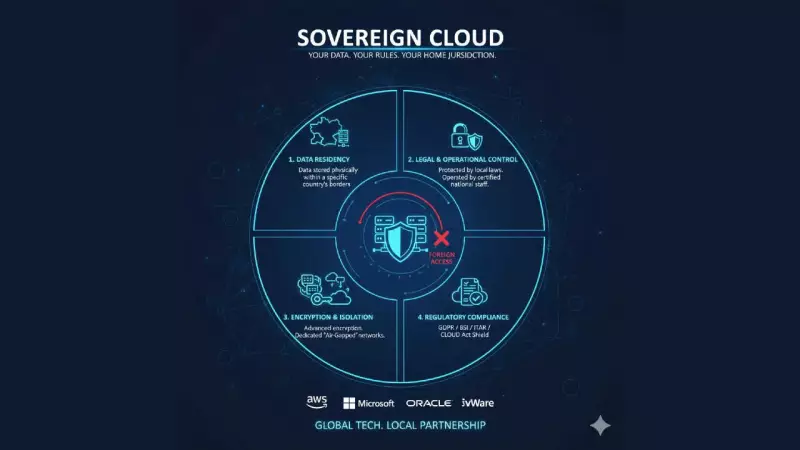
A sovereign cloud is a specialized cloud environment that enables organizations or countries to meet digital sovereignty criteria, including data residency, access control, and operational independence, while leveraging the advantages of the cloud model. It transcends the concept of a mere data center in a specific region; it represents a tailored infrastructure where all data, metadata, and administrative operations fall under the jurisdiction of a particular nation or region.
To simplify, a sovereign cloud may be hosted at a facility owned by a cloud computing provider but is accessible only to a specific organization's users and non-cloud IT systems via the internet or specialized, isolated communication links. For example, a U.S.-based company like ABC could offer a Sovereign Cloud facility in India through a trusted partner like XYZ, adhering to local regulations for specific data types. A notable instance is the strategic partnership between Thales and Google Cloud in France, which provides a secure, sovereign cloud for sensitive military data that remains within French borders.
Sovereign clouds can also be configured as separate "cloud-like" installations within a large organization's own data center. In this setup, ABC would have an installation that functions like a cloud environment, maintained by the cloud service provider but physically disconnected from the external world.
The Key Principles of Digital Sovereignty
Digital sovereignty rests on four fundamental pillars:
- Data storage: Determining the exact physical location of the data.
- Data privacy: Regulating who can access the data.
- Security and privacy: Implementing measures to protect data from hackers or outages.
- Legal controls: Establishing legal protections against foreign laws.
Sovereignty compliance often extends beyond basic data storage, requiring additional capabilities such as access restrictions based on citizenship or security clearances, control over data residency to keep data within a specific country, and strict adherence to technical and legal specifications set by local governments or industries like healthcare or defense. Some requirements may mandate that cloud maintenance personnel be residents or citizens of the country, and systems must be isolated from the public internet to ensure privacy and security. Data encryption, including customer-managed keys, is another critical condition for digital sovereignty.

Benefits of Cloud Sovereignty
Implementing a sovereign cloud offers numerous advantages. It ensures compliance with local laws, such as GDPR in Europe, helping organizations avoid hefty fines. Additionally, it provides access to advanced cloud technology without the need for in-house development, saving both time and money. Operational control is enhanced, as organizations know exactly who holds access to their digital assets. Sovereign clouds also offer supply chain efficiencies, as providers can procure hardware more easily than individual companies. Lastly, they provide geopolitical resilience, protecting data from potential disruptions during trade conflicts or foreign government interventions.
Challenges of Cloud Sovereignty
Despite its benefits, cloud sovereignty presents several hurdles. The complexity of rapidly evolving regulations makes it difficult to find providers that stay current. Determining the appropriate level of protection, including service types and encryption standards, can confuse customers. Disaster recovery poses another challenge, as data residency requirements may necessitate backup data centers within the same country, increasing local footprints. Delays in feature rollouts, particularly for AI tools, can occur as new features are often prioritized for global clouds. Finally, obtaining legal certifications for sovereign clouds is a time-consuming and costly process.
EU Sovereign Cloud: A Special Case
The European Union (EU) exemplifies an advanced region for sovereign cloud implementation. With multiple nations each having their own rules alongside EU-wide regulations like GDPR, a compliant sovereign cloud must satisfy both sets. This complexity is driven in part by the U.S. CLOUD Act, which allows U.S. law enforcement to demand data from U.S. companies even if stored abroad, creating legal conflicts for European entities. Unlike single-country models, the EU focuses on strategic autonomy through initiatives like Gaia-X, a federated ecosystem that promotes collaboration among European providers to reduce dependency on foreign tech giants.
Adoption by Big Tech Companies
By 2026, major tech companies have embraced sovereignty as a significant business opportunity. Key players include:
- Amazon Web Services (AWS): Launched the European Sovereign Cloud (ESC) in January 2026, a physically and logically isolated partition with no data transfer to the U.S., starting in Germany and expanding to Belgium, the Netherlands, and Portugal.
- Microsoft: Introduced the Microsoft Cloud for Sovereignty in 2025, partnering with entities like Thales in France and Delos Cloud in Germany, and expanding local data processing for Copilot AI to 15 countries, including India and Switzerland.
- Google Cloud: Focuses on "Trusted Cloud" partnerships, such as with Thales in France for defense data and T-Systems in Germany, offering AI tools while local partners manage encryption keys and data centers.
- Oracle: Operates EU Sovereign Cloud regions in Frankfurt and Madrid as of 2026, with infrastructure separate from commercial regions and no network connections to other cloud regions.
- VMware (Broadcom): Runs a Sovereign Cloud Initiative with over 50 global partners, providing software to local providers in regions like Northern Europe and India to enable sovereign cloud offerings.
Conclusion
In 2026, the focus for organizations and governments has shifted from questioning the need for a sovereign cloud to determining the optimal type and implementation speed. Whether for high-stakes government defense or protecting patient privacy in healthcare, sovereign clouds effectively bridge the gap between the ubiquitous access power of cloud computing and the imperative for absolute data control, marking a pivotal evolution in digital infrastructure.