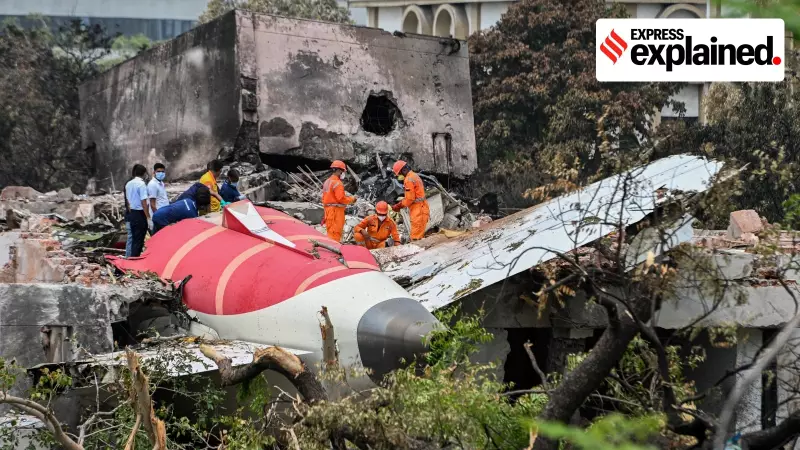
US Aviation Safety Group Alleges Boeing 787's Defect History in Air India Crash Investigation
A prominent US-based aviation safety advocacy organization has raised serious concerns about the ongoing investigation into the tragic Air India crash in Ahmedabad, shifting the focus from pilot actions to the aircraft's alleged history of technical defects. The Foundation for Aviation Safety (FAS) has submitted a detailed whistleblower report to US authorities, claiming that the Boeing 787-8 Dreamliner involved in the fatal accident had experienced numerous engineering and maintenance problems throughout its 11-year service life.
Details of the Alleged Aircraft Defects
In its presentation to the US Senate Permanent Subcommittee on Investigations, the FAS presented claims based on what it describes as non-public documents. According to the group, the specific aircraft bearing registration VT-ANB suffered from various electrical systems failures beginning from its very first day of operation in India on February 1, 2014. The alleged problems persisted throughout the aircraft's operational history, leading to multiple concerning incidents.
The FAS report specifically mentions:

- Repeated circuit breaker tripping incidents
- Multiple electronics and avionics faults
- Wire damage and short circuits
- Smoke and fume events
- Electrical surges and power distribution issues
- A serious fire incident in January 2022 that required complete replacement of the P100 Primary Power Panel
The safety group emphasized that these issues were not isolated to the crashed aircraft alone. Their analysis of over 2,000 aircraft systems failure reports covering approximately 18% of the global Boeing 787 fleet suggests similar problems have affected other aircraft of the same model registered in various countries including the United States, Canada, and Australia.
Challenging the Pilot-Focused Investigation Narrative
The FAS has strongly criticized what it perceives as an investigation overly focused on pilot actions rather than technical possibilities. The group points to India's Aircraft Accident Investigation Bureau (AAIB) preliminary report, which they believe implicitly suggests pilot error by mentioning that fuel control switches transitioned from 'RUN' to 'CUTOFF' position moments after takeoff.
"This approach mirrors the initial narrative following the Boeing 737 MAX crashes," the FAS stated in its presentation, referencing previous aviation disasters where investigations eventually revealed systemic technical issues rather than pilot error as primary causes.
The safety organization has expressed particular concern about what it terms "latent defects" - hidden flaws in aircraft design, manufacturing, or maintenance that can remain undetected for years before triggering catastrophic failures. They argue that such possibilities must be thoroughly investigated in the Ahmedabad crash case.
Industry Response and Ongoing Legal Challenges
Boeing has declined to comment directly on the FAS allegations, instead deferring to the official investigation being conducted by India's AAIB in accordance with international aviation protocols. Air India has similarly refrained from commenting on the matter, while attempts to reach the AAIB Director General for response have reportedly been unsuccessful.
The crash investigation has already faced significant challenges from various stakeholders:
- The Federation of Indian Pilots has strongly objected to the preliminary report's implications
- Aviation safety experts have called for more thorough investigation of potential system failures
- The father of pilot Sumeet Sabharwal has filed a writ petition in the Supreme Court challenging the fairness of the AAIB probe
- Multiple parties have demanded a judicial investigation rather than relying solely on the AAIB process
Broader Implications for Aviation Safety
The FAS has made several recommendations to US authorities, including urging the Department of Justice to investigate potential criminal aspects under Federal Criminal Statutes. The group has also called for full disclosure of all relevant information to the AAIB-led investigation team and comprehensive inspections of all Boeing 787 aircraft by the Federal Aviation Administration.

This development comes at a critical juncture in aviation safety discussions worldwide, particularly concerning Boeing aircraft. The Ahmedabad crash represents the first and only fatal accident involving a Boeing 787 in the aircraft type's 14-year commercial operation history, making its investigation particularly significant for future safety protocols and manufacturing standards.
As the investigation continues, aviation experts emphasize the importance of examining all potential causes thoroughly, including both human factors and technical possibilities, to ensure complete understanding of what led to this tragic accident that claimed 260 lives.