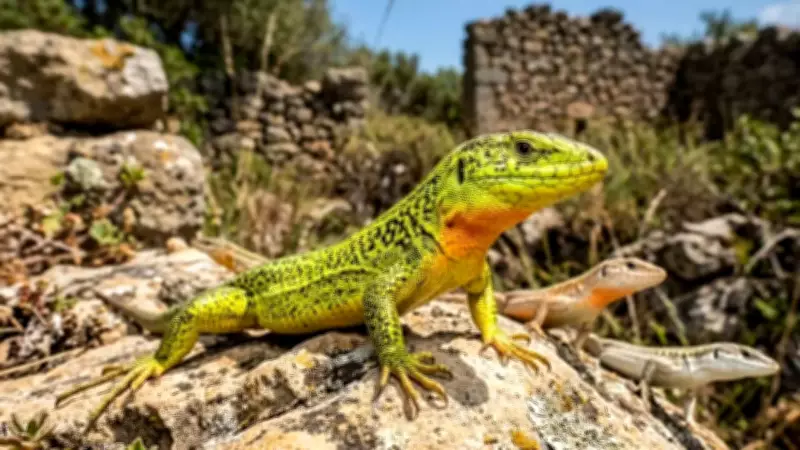
For millions of years, the common wall lizard maintained a fragile evolutionary balance with vibrant orange, yellow, and white-throated types coexisting in a stable 'rock-paper-scissors' social setup. However, a genomic analysis reveals that this ancient diversity is collapsing due to a rapidly expanding yellow-green 'Hulk' lineage. This dominant type possesses a co-adapted supergene that enables it to physically outperform and displace other color types at an unprecedented evolutionary rate. Scientists are now witnessing evolution in real time as this 'super-lizard' spreads across Europe, disrupting complex social systems and homogenizing what was once a diverse species into one aggressive form.
Millions of Years of Diversity Erased by a Single Dominant Lizard
A study published in the journal Science shows that the common wall lizard, Podarcis muralis, has maintained its distinct color forms—orange, yellow, and white—for approximately 3 million years. These colors remained stable because none had a lasting advantage over the others. But now, a new lineage called 'Green Hulk' has expanded its range. These lizards are larger and highly aggressive. Originating from Italy, this lineage is aggressively infiltrating local populations, triggering a selective sweep. As a result, yellow and orange varieties are disappearing rapidly, bringing an end to millions of years of coexistence.
How the Hulk Variant Inherits a Complete Competitive Edge
A detailed examination of the genome reveals that the Hulk variant thrives due to a special group of genes passed down together. This 'supergene' is not solely about color; it links green and yellow pigmentation with hormone levels and body size. Research supported by Lund University highlights that this genetic combination ensures Hulk offspring inherit all competitive traits, such as aggression and size. Consequently, they completely outcompete traditional morphs in territorial takeovers.

Aggressive Males Bullying Rivals into Extinction
Evolution is often perceived as a slow process taking thousands of years. However, this study sheds light on 'rapid evolution' or 'contemporary evolution.' Data from CNRS reveal that when a dominant morph enters a new area, it can lead to the collapse of local diversity in just a few dozen generations. The aggressive 'Green Hulk' males take over the best basking spots and mates, preventing other morphs from reproducing. This results in a selective sweep that removes ancestral genetic variety from the gene pool.
How the 'Hulk' Lizard Broke Nature's Rock-Paper-Scissors Balance
Typically, in nature, 'frequency-dependent selection' helps maintain diversity by giving rare types an edge. Yet, recent findings in Evolution Letters reveal that the 'Hulk' morph defies this norm due to its physical dominance in every social encounter. This strength disrupts the usual 'rock-paper-scissors' dynamic that once allowed orange and yellow lizards to thrive. As a result, the ecosystem shifts from a balanced state to one where only the strongest prevails. Such a change may weaken the species' ability to adapt to future environmental shifts.