Jenni Steiger did not come to Stanford to become an AI evangelist. She came, like most students in the Class of 2026, to acquire the standard MBA equipment: the frameworks, the network, the experience. Before business school she had spent her career at BlackRock, latterly on the team that ran Larry Fink's office. She is, by her own description, a bulldozer. She is not a coder.
In April of last year, in a class called Research Driven Innovation, a guest speaker Diego Oppenheimer ran a demonstration of what large language models could now do for research workflows. About halfway through, Steigler had what she would later describe as an "uh-oh" moment. The workforce she had left, she realized in real time, was not the workforce she would be returning to.
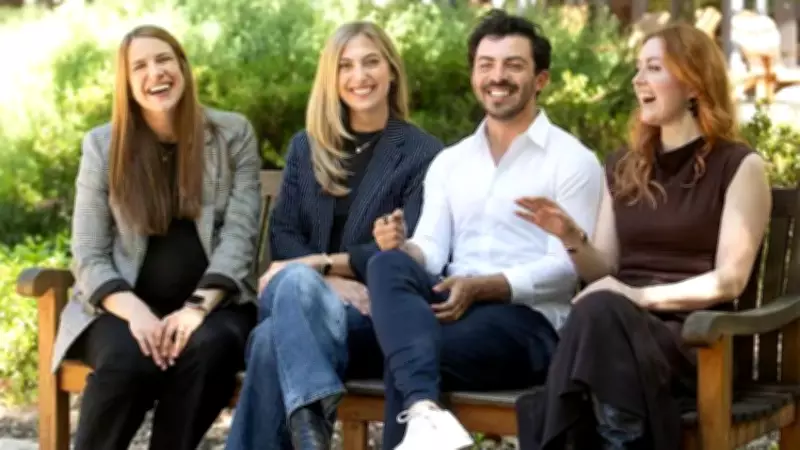
She sent a long email to the professor that night. By the next class, she was being called on to stand and explain it. Within months, the idea that an MBA in 2026 needed not just to learn about AI but to actually use it every day like a muscle, had become AI@GSB, a dean-backed initiative co-founded by Steiger, Celeste Bean, Abby Alder, and Alfredo Mendez. By autumn it was the largest student organization on campus. By this spring, in Steiger's own words, what isn't an AI project now?

Stanford Graduate School of Business sits roughly forty minutes' drive from the headquarters of OpenAI, Anthropic, and Google DeepMind. This is a kind of structural advantage. The school now runs about three dozen MBA courses that explicitly integrate AI or machine learning, and the courses that do not carry the label often quietly do anyway. The Startup Garage, GSB's flagship entrepreneurship course, opens with a sixty-minute AI hackathon. In a course called AI for Human Flourishing, run by the professor Jennifer Aaker, one student built something called the "Wisdom Cathedral": an application that auto-generates daily journal entries and, at year's end, hands you a summary of your biggest belief shifts.
Dean Sarah Soule, who took over in early 2025, has framed the school's task as a twofold one: arm students with the tools, and double down on the human capabilities the tools cannot replace. The more interesting fact about Stanford's AI moment, however, is that the heaviest lifting is being done by the students themselves, and that the school had the institutional wisdom to get out of their way.
Which brings us to Alfredo Mendez, who said, "I think everyone is technical now. But not everyone is curious… But we are all builders now." Read those again. There is a small revolution buried in them.
For most of the past two decades, technical was the most overvalued word in business. It was the word that separated the people who could build a thing from the people who could only direct one. It justified salary bands, founding-team hierarchies, and the strange premium attached to anyone who could write a Python loop. The whole architecture of Silicon Valley turned, in some measure, on the scarcity of people who could actually make the artifact.
That scarcity is now collapsing. With Claude Code, Cursor, and the new generation of agentic tools, the friction between idea and artifact is approaching zero. Mendez himself runs a workshop on Claude Code; in it, his classmates (many of whom have never written a line of code in their lives) have built mock-interview generators, clinical-trial trackers, an AI public-speaking coach. Steiger and Bean, who are now starting a company together, have wired up Gmail, Claude, Slack, Notion and Monday so that their tools speak to one another in something approaching real time. "I come from a very manual world," Steiger says. She does not, anymore.
If the technical floor has risen for everyone, then the variable that now separates people is something older and harder to teach: the disposition to wonder, to poke, to ask one more question, to genuinely want to know. Curiosity. The thing that the average school system spends fifty years drilling out of children, and that the present moment is going to reward more richly than any credential we have ever invented.

The other line bears sitting with. We are all builders now. For most of its history, the MBA was a credential, a document that certified you could plausibly be put in charge of things. You arrived with a résumé and you left with a slightly better one, plus a thicker rolodex. The classroom was, in essence, a finishing school for the managerial class.
What is happening at Stanford right now (and what will, inevitably, happen at every business school that wants to remain serious) is that the credential is being replaced by a workshop. Scott Brady, the venture investor who teaches the class where all this began, says he wants his students to think about AI the way they think about their own physical health. "If you don't do it for a week, you are going to get weaker." This is a metaphor about practice. About reps. About the fact that, in 2026, a great deal of what an elite institution can usefully give you is not a body of knowledge but the daily habit of building.
The students at the core of AI@GSB seem to understand this with unusual clarity. Mendez was asked, during a summer-internship interview, to show his portfolio of builds. One of Aaker's students built an agent that could negotiate trucking rates on behalf of independent operators, and was promptly absorbed by HappyRobot, a fast-growing logistics-AI startup, as a founding-team member. The line between coursework and product has dissolved.
There is a temptation, reading all this from a distance, to treat it as a Silicon Valley curiosity: another story about Stanford doing what Stanford always does, which is to be slightly ahead of everywhere else. That would be a mistake. What is happening on Knight Way is a small, early signal of a much larger rearrangement: the very meaning of education is shifting. The institutions that will matter most over the next decade are not the ones with the deepest course catalogues or the most prestigious faculty. They are the ones that grasp that the half-life of any specific technical skill has collapsed, and that the only durable curriculum is the one that makes building a daily habit and curiosity a kind of religion.
For India, which has spent two generations producing some of the most highly credentialed graduates in the world, this is both a warning and an extraordinary opportunity. MBA students at Stanford have figured something out that others would do well to listen to. Everyone is technical now. The people who matter, in the end, will be the ones who never lost the habit of asking why.