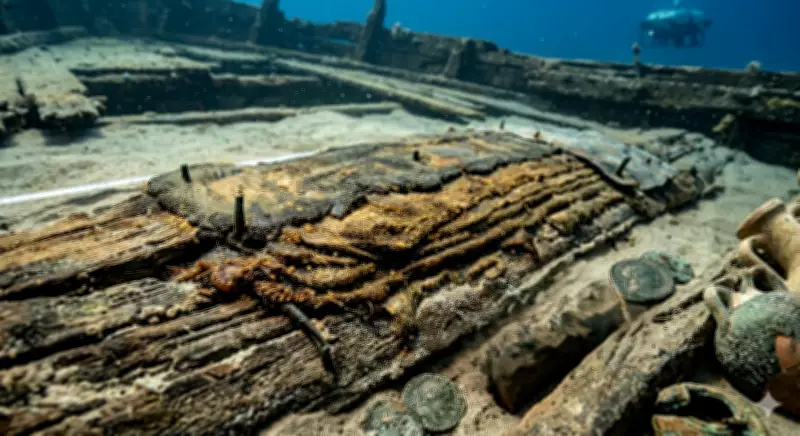
A Roman merchant ship that rested for over two millennia beneath the clear waters of the Adriatic Sea, off the coast of Ilovik, has been uncovered by a team of underwater archaeologists and divers. Buried in the sand, the shipwreck offers a rare glimpse into ancient maritime craftsmanship and durability.
A Testament to Ancient Seafaring
Dating back to the 2nd century BC, the ship provides valuable insights into the lives of ancient seafarers who navigated treacherous waters using only timber, tar, and sheer determination. The vessel shows signs of extensive patching and reinforcement, highlighting the resourcefulness of Roman sailors who kept the ship operational despite numerous challenges. This rare example of hidden repairs allows scientists to understand how Roman sailors adapted to keep their ships safe.
Advanced Waterproofing Techniques
During analysis of the hull, researchers discovered unusual dark coatings on wooden planks and fabric sealing the gaps. The findings, published in Frontiers in Materials, reveal that Roman sailors used a waterproof glue derived from resin sourced from multiple locations across the Mediterranean. This indicates a sophisticated supply network for marine glue, essential for maintaining the Roman merchant fleet. The resin was heated until it flowed like honey, applied to linen or wool cloth, and pressed into the hull's cracks.

Pollen Analysis Reveals Trade Routes
Pollen particles embedded in the waterproof sealants provided a biological map of the ship's journeys over its final years. The pollen evidence shows that the ship traveled from the southern Mediterranean northward to the Croatian coastline, with multiple repair sites along the way. This vessel served as a workhorse for the Roman Republic, transporting cargoes over vast distances.
The extensive Roman sea transportation system is evident not only in trade goods but also in shipbuilding. Amphorae filled with wine and olive oil were common cargo, and the efforts to repair the ship underscore its value—its destruction would have caused significant economic losses.
Modern Inspirations
Today, the shipwreck near Paržine on Ilovik continues to inspire scientists. History and civilization are not always captured in statues and coins but can be hidden in the resin and pollen within an ancient vessel's wooden hull. This discovery sheds light on the ingenuity of Roman seafarers and their enduring legacy.