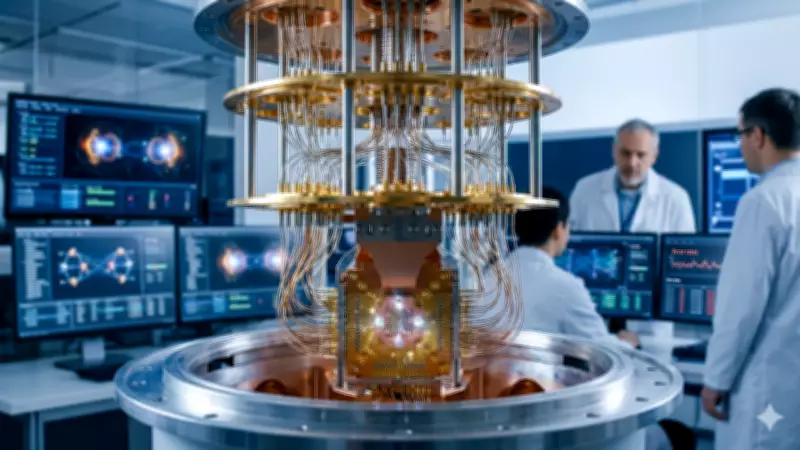
Physicists have modeled a quantum mechanism that could trigger the end of the universe through false vacuum decay, a process rooted in quantum field theory and cosmology. Scientists have investigated how an unstable vacuum state, known as a false vacuum, can transition into a true vacuum, leading to a catastrophic event that would destroy the cosmos. Using quantum computing, Rydberg atoms, and quantum annealing techniques, researchers have studied bubble nucleation, vacuum instability, and cosmic phase changes.
What Is False Vacuum Decay in Quantum Physics?
At the heart of this investigation lies a nearly metaphysical concept: empty space is not truly empty. Quantum field theory suggests that the vacuum, while being the state of lowest energy, is not necessarily the ground state. In the study titled 'False Vacuum Decay in Quantum Spin Chains,' scientists argue that our universe might reside in a false vacuum—a stable state that is not the most stable possible. If a more stable condition, or true vacuum, exists, the transition from one to the other is called false vacuum decay. This phenomenon would occur suddenly, originating from a tiny bubble that expands outward at the speed of light.
How Scientists Simulated a Universe-Ending Quantum Process
A recent breakthrough was achieved in the paper 'Stirring the False Vacuum via Interacting Quantised Bubbles on a 5,564-Qubit Quantum Annealer.' Researchers simulated the formation of false vacuums using Rydberg atoms arranged in a ring and excited with lasers, creating two distinct energy states: false vacuum and true vacuum. They observed the decay from false vacuum to a lower energy state, as predicted theoretically. Another team from the University of Leeds used a quantum annealer with thousands of qubits to simulate the formation, growth, and interaction of vacuum bubbles. According to a professor of particle physics at the university, the consequences would be disastrous: 'The universe will fundamentally change its structure…collapse like a house of cards.'

Could This Process Really End the Universe?
Yes, but not instantly or predictably. False vacuum decay could occur anywhere at any time. If it happened, the expanding bubble would travel at light speed, leaving no chance for detection or escape. As one scientist put it, 'Whatever was… would disappear immediately.' However, this process is considered extremely unlikely. Existing theories suggest that if it occurs, it would happen over millions or even billions of years.
Why This Research Matters for Understanding the Cosmos
While these simulations might seem apocalyptic, they are invaluable for investigating one of physics' greatest challenges: unifying quantum mechanics and general relativity. False vacuum decay sits at the heart of this problem. By simulating it, scientists can study how basic physical laws operate under extreme conditions, potentially revealing insights into the universe's nature. It could even shed light on the universe's origin, as some theories propose that a transition similar to false vacuum decay occurred shortly after the Big Bang. Essentially, these simulations help science understand the fundamental laws of physics in action.
A Quiet but Profound Implication
There is an inherent unease in this concept. Although the universe appears consistent, logical, and eternal, science suggests that its stability might be temporary. For now, it remains a theory, not a reality. Yet the ability to model this theory demonstrates how far we have progressed. It reminds us that much about the universe remains unknown and that even nothingness may be far from passive.