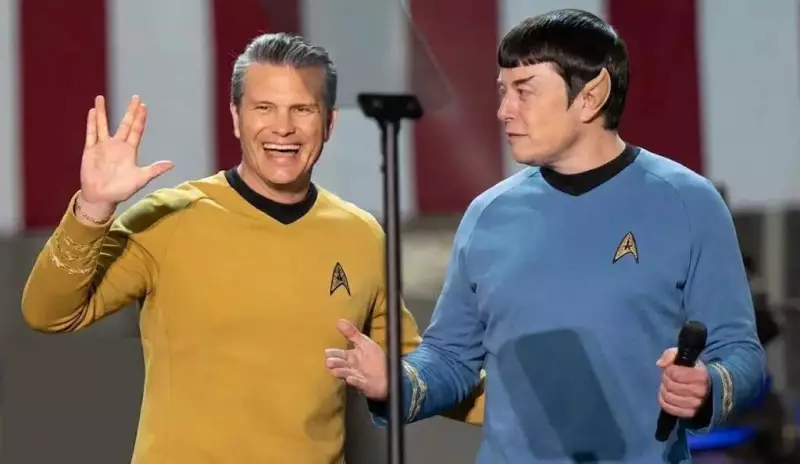
Defense Secretary Pete Hegseth recently traveled to Elon Musk's SpaceX Starbase in South Texas. This visit was part of his "Arsenal of Freedom" tour. Standing next to Musk, Hegseth echoed Musk's famous line about making Star Trek real. He even gave the Vulcan salute during the event.
The Viral Moment and Serious Message
That moment quickly spread across social media. However, it was connected to a much more significant announcement. The Pentagon is completely rewriting how it develops and deploys military technology. Hegseth delivered a clear message. Modern warfare no longer depends on counting tanks or aircraft. Instead, it hinges on how fast a nation can integrate data, software, and machines.
He argued that the United States has been stuck running what he called a peacetime science fair. Meanwhile, America's rivals are engaged in a full-blown wartime arms race. This stark comparison highlights the urgency of the situation.

Identifying What's Broken in the Pentagon
Hegseth has been unusually direct in his criticism of the Pentagon's internal culture. He states that the system for fielding new capabilities has failed to keep pace with evolving threats. It is buried under excessive layers of bureaucracy.
Projects often drag on for years without clear ownership. Vast sums of money are spent with little to show for it. Innovation arrives so slowly that it becomes irrelevant by the time it's deployed. Hegseth warns this is not merely inefficient. It is a genuine danger to national security.
The United States still holds massive advantages. These include financial capital, a vibrant community of entrepreneurs, deep operational experience, and advanced classified technology. Yet, Hegseth argues these strengths are meaningless if they are smothered by internal processes and red tape.
The Shift to an AI-First Military Strategy
During his visit to Starbase, Hegseth outlined a concrete plan for change. He announced that AI models like Elon Musk's Grok and Google's Gemini will be deployed. They will operate across both classified and unclassified Pentagon networks. These systems will not be passive tools. They will be integrated directly into the military's core digital infrastructure.
Hegseth has issued a directive. All appropriate data from across the Defense Department must be shared. This includes intelligence databases and operational records. The goal is to train AI systems on this vast repository of information.
His logic is straightforward. Artificial intelligence is only as effective as the data it learns from. No other military in the world possesses more real-world combat data than the United States. This data is intended to power critical functions. It will enhance planning, logistics, targeting, and overall battlefield awareness.
No Ideological Filters on Military AI
Hegseth has made another crucial point clear. The Pentagon's AI will not be constrained by what he describes as ideological limits. He stated the department will not use AI models that refuse to support lawful military operations. The primary objective is to ensure the technology can be practically used in combat scenarios. It should do more than just generate reports.
This stance aligns closely with Elon Musk's own vision for Grok. Musk pitches it as a system free from political or cultural restrictions. The Pentagon seems to be adopting a similar, pragmatic approach.
Breaking the Old Procurement Model
This technological push is accompanied by fundamental changes in procurement. Hegseth has told defense contractors that the old way of doing business is finished. He demands faster development timelines, increased competition, more open systems, and clear accountability.
He openly praised SpaceX as the antithesis of the Pentagon's legacy culture. At SpaceX, projects move at incredible speed. Failure is used as a learning tool to improve designs. Results consistently matter more than paperwork. Hegseth explicitly stated he wants to replicate this model inside the military establishment.
A New Command Structure for Technology
To drive this monumental shift, Hegseth has appointed a new chief digital and artificial intelligence officer. This role is filled by a former Amazon Web Services executive. The position is designed to centralize control over data, software, and AI across the entire department.

A key goal is to prevent different military services from hoarding information or building incompatible systems. The aim is to create a unified digital and AI architecture. In this new framework, information will be treated as a shared strategic asset. It will no longer be locked away in separate silos.
Why the Star Trek Imagery Truly Matters
The Vulcan salute at Starbase was far more than a playful gesture. It served as a powerful signal. It revealed how Hegseth and the current administration view the future of military power. They are betting that dominance in the coming era will come from speed, advanced computation, and interconnected systems.
It will not come from a slow-moving, industrial-era bureaucracy. In this vision, the Pentagon should resemble a technology company operating at a permanent wartime pace. It should look less like a traditional procurement office.
Whether this ambitious overhaul produces smarter, more effective warfare or simply leads to faster mistakes remains to be seen. What is already evident is the scale of the change. The U.S. defense establishment is being pushed to remake itself entirely. It is reorganizing around artificial intelligence, data-centric strategies, and the Silicon Valley mindset. Elon Musk and SpaceX now stand as the defining cultural template for this transformation.