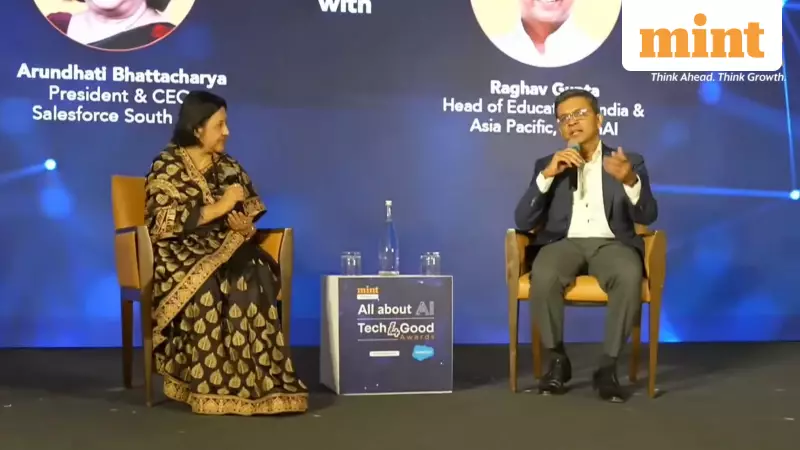
The rapid rise of generative artificial intelligence, with tools like ChatGPT leading the charge, has sparked a complex mix of hope and concern within India's vast education landscape. A central debate revolves around how students should use this powerful technology for their studies. This critical issue took centre stage during a fireside chat at the recent Mint All About AI Tech4Good Awards & Summit, sponsored by Salesforce.
From Answer Bot to AI Tutor: The Study Mode Solution
The conversation featured Arundhati Bhattacharya, President and CEO of Salesforce South Asia, and Raghav Gupta, Head of Education for India and Asia-Pacific at OpenAI. Bhattacharya voiced a common parental worry: that students might use AI to bypass genuine learning by simply generating homework answers. Gupta, acknowledging his own perspective as a parent, detailed OpenAI's product-level response to this challenge.
He introduced 'Study Mode', a feature recently added to ChatGPT based on feedback from Indian parents, teachers, and regulators. "If you click on the plus button at the bottom left of ChatGPT you switch on study mode. ChatGPT stops being somebody who gives you an answer but becomes like an AI tutor for you," Gupta explained. This approach guides students to think through problems and discover answers themselves, rather than providing them outright.

"Learning does take effort. If my child is in class 5... if I hand them a calculator there is no way that they will learn multiplication," he said, emphasising the need for responsible use. Gupta stressed that collaborating with educational institutions to provide guidance is crucial.
Scaling Quality Education and Building AI Literacy
The dialogue highlighted education as a foundational solution for national challenges. Gupta revealed that education is the number one use case for ChatGPT globally. With nearly 800 million weekly users worldwide, India and the US are the largest markets, and India leads specifically in student usage.
The core challenge identified was democratising high-quality learning. "We have some great institutions, the IITs and IIMs, but then we also have a lot of very average institutions. How do you take higher quality education to everybody?" Gupta asked. He also pointed out the urgent need to create more AI-literate students who are prepared for the future workforce.
To address this, OpenAI is pursuing localised impact through two key initiatives:
- Contextual Learning: Partnering with schools in remote areas, like one in Leh, to train teachers on using ChatGPT to generate locally relevant educational material.
- Research & Development: Collaborating with IIT Madras on AI research to ensure technology outcomes are tailored for the Indian context.
Democratising AI: Voice, Vision, and Indian Languages
The conversation shifted to making AI inclusive for India's diversity. Gupta outlined OpenAI's focus on inclusion by ensuring ChatGPT performs well in Indian languages, understands local context, and is accessible at a relevant price point.
He shared a personal story illustrating the power of multimodal AI (voice and vision). Using the Voice Mode feature and his phone's camera, he diagnosed a plant health issue for his gardener in Hindi. The AI could "actually see what you are seeing" and offer a solution in the local language. The vision is to extend this Voice + Video capability to farmers, enabling instant assessment of crops, weather, or market prices, thus empowering those with low literacy.
The Roadmap for India's AI Future
Looking ahead three years, Gupta stated that good technology earns its place by helping everyday life and securing livelihoods in a country like India. He proposed a three-part roadmap for India:

- Scale Effective Usage: Moving beyond basic prompting to enable people to use the technology powerfully. "This is not Google search. There is a lot more to it," he noted.
- Contextualisation for India: Improving AI models to understand India's diverse cultural needs. To measure this, OpenAI launched India QA (INDQA), an evaluation framework of 2,500 questions built with 300 Indian experts.
- Drive Safe and Secure Usage: Ensuring models are built to benefit society and prevent harm.
On training younger generations, Gupta observed that youth are digital natives already comfortable with AI; the focus must be on teaching responsible use.
The fireside chat ultimately framed generative AI not just as an efficiency tool, but as a potent force for social good. By combining AI literacy, culturally apt tools like Study Mode and INDQA, and accessible multimodal inputs, a clear path emerges for making advanced technology inclusive. For India, democratising access to quality education and vital information through AI is a decisive step toward a more empowered future.