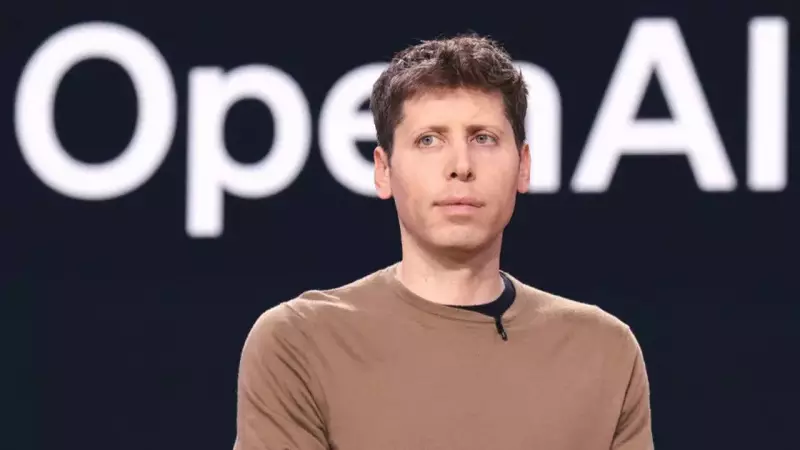
In a dramatic turn of events, OpenAI has declared an internal state of emergency, shifting its entire focus to salvage ChatGPT's competitive standing. This move comes three years after ChatGPT's launch sent shockwaves through Silicon Valley and put Google on the defensive. Now, the tables have turned completely, with Google's Gemini AI model surging ahead in performance, user engagement, and market share.
OpenAI Scrambles: From Growth to Survival Mode
According to internal memos obtained by The Wall Street Journal and The Information, OpenAI CEO Sam Altman has escalated the company's internal alert level from "code orange" to "code red." This is the highest urgency designation for what the company perceives as an existential threat. In a memo first reported by The Information, Altman stated, "We are at a critical time for ChatGPT."
The directive orders employees to immediately halt work on several planned revenue-generating features. This includes:

- Introducing advertising within ChatGPT.
- Developing AI shopping assistants.
- Building specialized health agents.
- Advancing the Pulse personal assistant project.
Instead, all engineering and financial resources are being redirected toward a single goal: improving ChatGPT's core user experience. The focus will be on enhancing its speed, reliability, and personalization capabilities. Altman referred to the current situation as facing "temporary economic headwinds" due to Google's aggressive push in artificial intelligence.
Google's Full-Stack Advantage Proves Decisive
Google's remarkable comeback is built on a foundational advantage that OpenAI struggles to match: control of the entire AI "stack." As explained by DeepMind CTO Koray Kavukcuoglu, Google's approach is deeply integrated. Its DeepMind researchers build the models, they are trained efficiently on Google's own custom TPU (Tensor Processing Unit) chips, hosted on Google Cloud, and seamlessly deployed to billions of users through Search, YouTube, Gmail, and Android devices.
In contrast, OpenAI relies on Microsoft's cloud infrastructure and Nvidia's expensive GPUs, creating a structural cost disadvantage. This integrated power is showing clear results in the market.
Google's Gemini user base exploded from 450 million monthly active users in July to 650 million by October 2024. Analytics from Similarweb indicate users are now spending more time interacting with Gemini than with ChatGPT, despite OpenAI's claim of having 800 million weekly users. Technically, Google's latest Gemini 3 model has outperformed OpenAI's GPT-5 on key industry benchmarks, and its Nano Banana Pro image generator is gaining significant traction.
The competitive pressure isn't coming just from Google. Anthropic's Opus 4.5 model has also beaten GPT-5 in crucial tests, squeezing OpenAI from multiple sides.
Financial Realities and Industry-Wide Shockwaves
OpenAI's strategic retreat is compounded by severe financial pressures. A report from The Wall Street Journal revealed the company needs to achieve roughly $200 billion in annual revenue by 2030 to reach profitability. This requires a hundred-fold growth while it currently burns billions of dollars every quarter on computing costs and top-tier talent.
Meanwhile, Google sits on a formidable war chest, generating $120 billion in annual revenue with nearly $100 billion in cash reserves. This financial muscle allows Google to offer advanced AI models for free or at very low cost, a luxury OpenAI, desperate for monetization, cannot afford.
The tremors from Google's AI success are being felt across the tech industry. In a stunning development, Nvidia's stock price plummeted over 6%, erasing about $250 billion in market value. This crash followed reports that Meta Platforms is in advanced talks to purchase billions of dollars worth of Google's TPU chips instead of Nvidia's GPUs. If this shift materializes, Nvidia could lose up to 10% of its annual revenue, as Google's custom silicon proves to be a cheaper and more efficient alternative for specific workloads.

This marks a spectacular role reversal from December 2022, when ChatGPT's debut forced Google CEO Sundar Pichai to issue his own "code red," restructuring divisions and accelerating AI timelines. Today, OpenAI's emergency directive—and the shelving of the very advertising plans it needs for survival—reveals deep anxiety about whether the pioneer of the generative AI boom can maintain its lead against a tech giant now operating at full throttle.