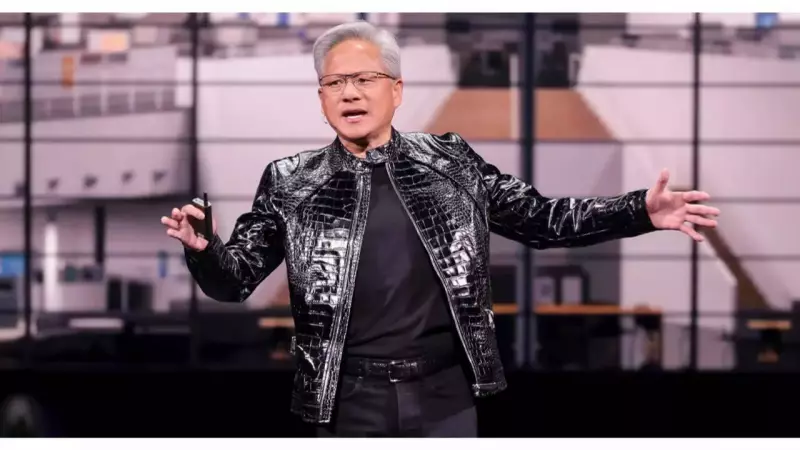
Jensen Huang, the CEO of chipmaking giant Nvidia, has strongly criticized what he calls the "doomer narrative" surrounding artificial intelligence. The 62-year-old executive believes that scary stories about AI's future, promoted by influential figures, are causing real damage to the world.
A Battle of Narratives in 2025
Speaking on the "No Priors" podcast, Huang described 2025 as a year defined by a "battle of narratives." This battle pits those who are hopeful about AI against those who fear its potential. Huang acknowledged that being careful with new technology is reasonable. However, he argued that some famous experts have gone too far with their warnings.
"I think we've done a lot of damage with very well-respected people who have painted a doomer narrative, end of the world narrative, science fiction narrative," Huang stated during the podcast. "And I appreciate that many of us grew up and enjoyed science fiction, but it's not helpful. It's not helpful to people. It's not helpful to the industry. It's not helpful to society. It's not helpful to the governments."

Unnamed Critics and Regulatory Concerns
Huang did not name the specific individuals he was criticizing. He also did not provide a clear reason why some people hold a negative outlook on AI. Instead, he pointed to concerns about "regulatory capture." Huang argued that no company should approach governments to request more regulation.
"Their intentions are clearly deeply conflicted, and their intentions are clearly not completely in the best interest of society," he explained. "I mean, they're obviously CEOs, they're obviously companies, and obviously they're advocating for themselves."
The Impact of Pessimism on AI Investment
Huang noted that excessive negativity is changing public discourse about AI. He expressed concern that fear is preventing necessary investments. "When 90% of the messaging is all around the end of the world and the pessimism, I think we're scaring people from making the investments in AI that make it safer, more functional, more productive, and more useful to society," he said.
Previously, Huang disagreed with Anthropic CEO Dario Amodei's prediction. Amodei suggested AI could replace up to half of all white-collar entry-level jobs within five years. Amodei later claimed that Huang misrepresented his views.
Other Tech Leaders Seeking a New AI Story
Jensen Huang is not alone in wanting to change the narrative around artificial intelligence. Other tech CEOs are also hoping for a different AI story in 2026.
Microsoft CEO Satya Nadella addressed this in his year-end note. He expressed a desire for society to move beyond labeling AI-generated content as "slop."
"We need to get beyond the arguments of slop vs sophistication," Nadella wrote on his blog. "And develop a new equilibrium in terms of our 'theory of the mind' that accounts for humans being equipped with these new cognitive amplifier tools as we relate to each other."
The push from leaders like Huang and Nadella highlights a growing effort within the tech industry. They aim to foster a more balanced and constructive discussion about the future of artificial intelligence and its role in society.