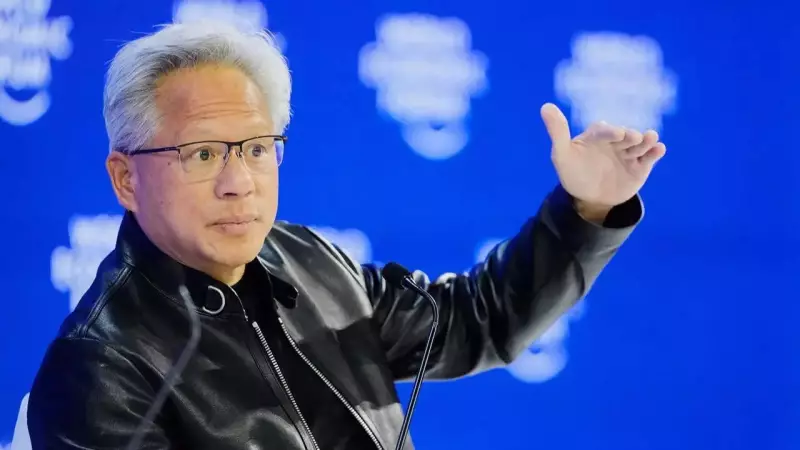
Nvidia CEO Jensen Huang has declared that artificial intelligence robotics represents a "once-in-a-generation" opportunity for Europe. Speaking at the prestigious World Economic Forum in Davos, the chief executive of the semiconductor powerhouse emphasized that the continent possesses an "incredibly strong" industrial and manufacturing foundation that positions it uniquely for this technological leap.
Fusing Industrial Might with Artificial Intelligence
Huang elaborated on his vision, stating that Europe now has the chance to combine its traditional industrial capabilities with cutting-edge AI. "You can now fuse your industrial capability, your manufacturing capability, with artificial intelligence, and that brings you into the world of physical AI, or robotics," he explained during his address. This convergence, according to Huang, could enable Europe to "leap past" the software era that has been dominated by other regions, charting a new course in the global tech landscape.
Growing Momentum in Robotics Across Sectors
The interest in autonomous robotics has surged dramatically across both industrial and technology sectors, fueled by recent breakthroughs in artificial intelligence. Over the past year, numerous prominent European industrial giants have announced significant robotics initiatives and strategic partnerships. Companies such as Siemens, Mercedes-Benz Group, Volvo, and Schaeffler have all unveiled projects collaborating with robotics technology firms, signaling a broad-based shift toward automation and intelligent systems.

This trend extends beyond traditional manufacturing. Big Tech companies are also intensifying their focus on robotics development. In a notable projection, Tesla CEO Elon Musk suggested that 80% of his company's future value would derive from its Optimus humanoid robots by September 2025. Similarly, Google's AI division, DeepMind, released advanced robotics AI models in 2025, while Nvidia itself announced partnerships with Alphabet to advance physical AI research in March of that year.
Record Investment and Infrastructure Challenges
The financial markets have taken keen notice of this robotics revolution. According to data from deal-tracking platform Dealroom, companies specializing in robotics raised a record-breaking $26.5 billion in 2025, underscoring the massive investor confidence in this sector. However, Huang also pointed out a critical challenge facing Europe's AI ambitions: energy infrastructure.
"I think that it's fairly certain that you have to get serious about increasing your energy supply so that you could invest in the infrastructure layer so that you could have a rich ecosystem of artificial intelligence here in Europe," Huang cautioned. Europe has been grappling with limited access to reliable energy even as major technology corporations seek to deploy extensive AI infrastructure across the region.
The Largest Infrastructure Buildout in History
Huang described the current AI expansion as showing "no signs of slowing down," characterizing it as the "largest infrastructure buildout in human history." He provided a staggering scale for this undertaking, telling the WEF audience, "We're now a few hundred billion dollars into it. There are trillions of dollars of infrastructure that needs to be built out." This monumental investment highlights the transformative economic and technological shift underway, with Europe poised to play a central role if it can address its energy and infrastructure needs effectively.
The convergence of Europe's robust industrial base, advancing AI capabilities, and growing corporate and investor interest creates a pivotal moment. As Huang's remarks underscore, the region stands at the threshold of potentially redefining global leadership in the emerging era of intelligent robotics and physical AI systems.