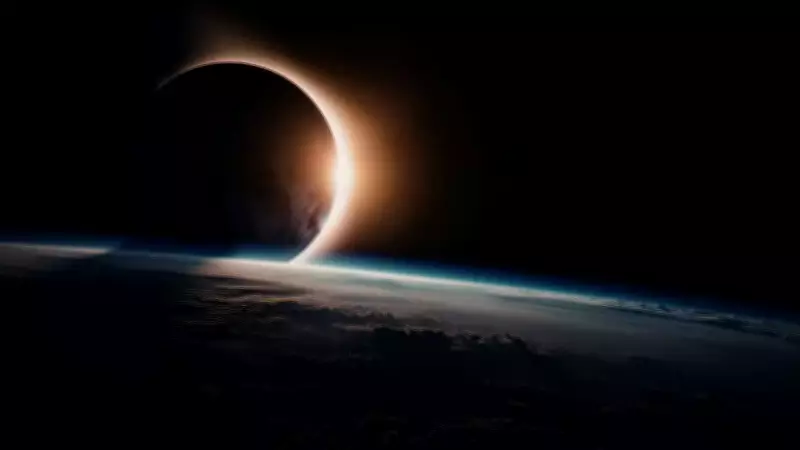
NASA Reveals Lunar Eclipse From Moon's Perspective: Earth Blocks Sun
When skywatchers on Earth observe a lunar eclipse, they witness the Moon gradually entering Earth's shadow and adopting a reddish hue for a brief period. This celestial event is a familiar spectacle for astronomy enthusiasts. However, have you ever pondered how a lunar eclipse appears from the Moon itself? Recently, NASA addressed this intriguing question by sharing a compelling visual on its official Solar System account on X.
What Happens During a Lunar Eclipse
A lunar eclipse occurs when the Sun, Earth, and Moon align in a straight line, with Earth positioned in the middle. This alignment places the Moon within Earth's shadow. When the alignment is perfect, the Moon moves into the darkest region of Earth's shadow, known as the umbra. During this phase, the Moon often exhibits a red coloration. This red hue arises because sunlight passes through Earth's atmosphere and bends toward the Moon. The atmosphere scatters blue light while allowing more red light to reach the lunar surface.
From Earth, this phenomenon manifests as the Moon slowly dimming and then glowing in a deep copper shade. The visual shared by NASA has garnered significant attention because it presents this familiar event from an entirely novel angle.

NASA Reveals How a Lunar Eclipse Looks From the Moon
From the lunar perspective, the experience is markedly different. According to NASA's Solar System post on X, the Lunar Reconnaissance Orbiter captured what transpires on the Moon's surface during a lunar eclipse. Instead of the Moon entering darkness, the spacecraft observed Earth moving in front of the Sun. In simpler terms, astronauts stationed on the Moon would witness a solar eclipse caused by Earth.
In this unique view, Earth appears as a dark circle obstructing the bright Sun. Around Earth's edge, a faint reddish ring is visible. This glow is generated by sunlight traversing Earth's atmosphere. The same atmospheric filtering that imparts a red appearance to the Moon from Earth creates a luminous ring around Earth when viewed from the Moon.
NASA's Lunar Reconnaissance Orbiter and the Eclipse Video
The images and video were recorded by NASA's Lunar Reconnaissance Orbiter, commonly referred to as LRO. Since 2009, this spacecraft has been orbiting the Moon. Its primary mission involves mapping the lunar surface and gathering data about its environment.
LRO is uniquely positioned to document how Earth blocks sunlight during a lunar eclipse. NASA's latest video illustrates how the Moon's surface darkens as Earth's shadow traverses it. The footage provides scientists with valuable insights into the behavior of light and shadow in space.
As per NASA's post, this perspective aids in comprehending that eclipses are fundamentally about alignment and shadows.
Why the Moon Turns Red During a Total Lunar Eclipse
During a total lunar eclipse, the Moon does not vanish entirely. Instead of turning blue or green, it adopts a red or orange tint. This occurs because Earth's atmosphere bends sunlight, directing it toward the Moon. The atmosphere permits longer red wavelengths to pass through while blocking shorter blue wavelengths.
This filtered light produces a reddish ring around Earth when observed from the Moon's surface. The same light emanating from Earth causes the Moon to appear red. Consequently, total lunar eclipses are occasionally termed blood moons.
The intensity of the color can vary based on factors such as dust, clouds, and particles present in Earth's atmosphere during the eclipse.
Why This Rare Moon Perspective Matters
Viewing a lunar eclipse from the Moon elucidates a straightforward yet profound concept. Eclipses are not mysterious phenomena; they result from the alignment of celestial bodies and the movement of shadows. From Earth, it seems as though the Moon is undergoing a transformation. From the Moon, however, it appears that the Sun is positioned behind Earth.
NASA's visual demonstration facilitates a clearer understanding of the interactions between the Moon, Earth, and Sun in space. It also showcases how scientists can examine familiar occurrences from fresh vantage points using spacecraft like the Lunar Reconnaissance Orbiter.

Skywatchers can now envision what it would be like to experience a lunar eclipse from the Moon's surface. Rather than observing a darkened Moon, they would see Earth positioned between the Sun and the lunar horizon, encircled by a faint ring of light.