For more than a century, cosmic rays have remained one of astronomy's most persistent puzzles. These tiny particles traverse space carrying immense energy, arriving from distant corners of the universe and occasionally passing through our cosmic neighborhood. Scientists have long known that violent events like exploding stars can produce cosmic rays, but the precise mechanisms that accelerate particles to such remarkable speeds have been difficult to determine.
NASA Juno Investigates the Role of Jupiter's Foreshock in Cosmic Ray Origins
Every planet with a magnetic field interacts with the constant stream of charged particles flowing outward from the Sun. Where this flow meets a planet's magnetic influence, a complex boundary forms, and conditions there are far from calm. According to NASA, one particular area ahead of the boundary, known as the bow shock, appears to play a crucial role in boosting particle energies. This region, called the foreshock, exists where incoming solar particles begin interacting with magnetic disturbances before reaching the planet's protective magnetic barrier. The foreshock is not a fixed structure; magnetic conditions shift continuously, creating an environment capable of energizing particles that pass through it. Scientists have suspected for years that this region could act as a natural particle accelerator, but gathering direct evidence outside Earth's vicinity has proven challenging.
NASA Juno Detects High-Energy Electrons Near Jupiter
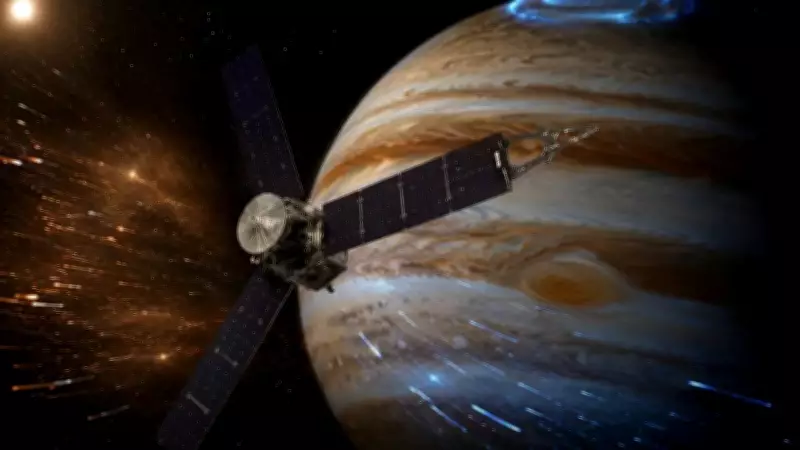
While orbiting Jupiter, NASA's Juno spacecraft detected electrons traveling at extremely high velocities within the giant planet's foreshock region. These measurements offered a rare opportunity to examine particle acceleration around a magnetic environment far larger than Earth's. Jupiter's immense magnetic field creates an equally substantial bow shock, and the scale of that interaction appears to influence the energies particles can achieve. According to NASA, electrons observed near Jupiter reached higher energies than similar particles previously measured near Earth. This result is significant because it strengthens an idea that has gradually emerged from earlier missions studying Earth's magnetic surroundings. Spacecraft such as MMS and THEMIS had already revealed that electrons could gain substantial energy in Earth's foreshock. What remained uncertain was whether the same mechanism operated in larger systems elsewhere. Jupiter has now provided a compelling test case.

What Jupiter Reveals About Cosmic Ray Origins Across the Universe
The implications of these findings extend well beyond Jupiter itself. Researchers compared the relationship between particle energies and bow shock size with observations associated with cosmic rays originating from supernova remnants across the Milky Way. The pattern appeared strikingly consistent: larger magnetic environments seemed capable of accelerating particles to correspondingly greater energies. In simple terms, the process observed near Jupiter may represent a scaled-down version of what occurs around some of the universe's most powerful events. This connection is particularly valuable because supernovas are far away and difficult to study in detail. Planetary environments, by contrast, can be examined directly by spacecraft carrying specialized instruments. Observations from within our Solar System, therefore, provide a practical way to investigate processes that may also operate across interstellar space.

Why NASA Juno's Cosmic Ray Discovery Matters
Cosmic rays influence far more than academic discussions about the universe. Energetic particles emitted by the Sun can affect satellites, communications systems, and electrical infrastructure when they reach Earth. Understanding how such particles are accelerated remains an important part of space weather research. According to NASA, the new findings suggest that a common acceleration process may link environments as different as planetary foreshocks and exploding stars. Although many questions remain about the full range of cosmic ray sources, Jupiter has offered an unusually clear glimpse into one mechanism capable of pushing particles toward near-light speeds. What makes the result especially interesting is its simplicity: a process taking place near a planet in our own Solar System appears to echo behavior occurring across vast galactic distances. Sometimes answers to the universe's biggest questions emerge not from looking farther away, but from examining familiar places with greater precision.