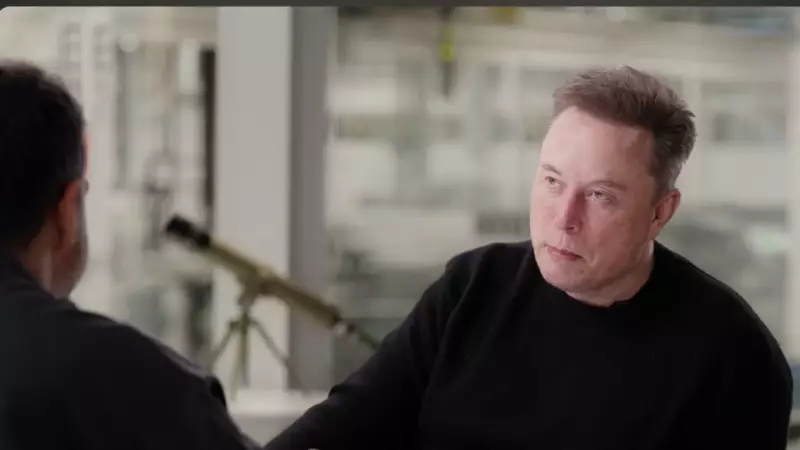
In a revealing conversation with Zerodha co-founder Nikhil Kamath on the "People by WTF" podcast, tech billionaire Elon Musk shared groundbreaking predictions about the future of employment while offering critical perspectives on US trade policies and immigration systems.
The Tariff Debate: Musk's Failed Attempt to Persuade Trump
Elon Musk disclosed his unsuccessful efforts to convince former President Donald Trump to reconsider his aggressive tariff strategy. The Tesla CEO revealed that despite his attempts to advocate for free trade principles, Trump remained firmly committed to protectionist policies.
"I mean, the President has made it clear he loves tariffs. You know, I've tried to dissuade him from this point of view, but unsuccessfully," Musk stated during the podcast conversation.

Elaborating on his anti-tariff stance, Musk compared international trade barriers to hypothetical tariffs between cities or individuals. "Generally free trade is a better, is more efficient. Tariffs tend to create distortions in markets," he argued, emphasizing how such barriers would make everyday life unnecessarily complicated if applied at smaller scales.
The Future of Work: AI and Robotics Revolution
Musk delivered his most striking prediction about how artificial intelligence and robotics will transform the employment landscape within the next two decades. He confidently stated that technological advancements will make traditional employment optional rather than necessary for survival.
"My prediction is, in the future, working will be optional. They don't have to— I mean, look, obviously, people can play this back in 20 years and say, 'Look, Elon made this ridiculous prediction and it's not true.' But I think it will turn out to be true that, in less than 20 years, but maybe even as little as, I don't know, ten or 15 years, the advancements in AI and robotics will bring us to the point where working is optional," Musk told Kamath.
The visionary entrepreneur compared future work choices to gardening as a leisure activity rather than an economic necessity. "In the same way that, like, say, you can grow your own vegetables in your garden or you could go to the store and buy vegetables. You know. It's much harder to grow your own vegetables. But some people like to grow their vegetables, which is fine. But it'll be optional, in that way, is my prediction," he explained.
Musk painted a picture of near-limitless abundance driven by accelerating technological progress. "I'm confident that if AI and robotics continue to advance — which they are advancing very rapidly — like I said, working will be optional, and people will have any goods and services that they want. 'If you can think of it, you can have it' type of thing," he declared.
H-1B Visa Program: Support with Reservations
Musk also addressed the controversial H-1B visa system, expressing support for high-skilled immigration while acknowledging systemic flaws. He identified specific problems within the program that require immediate attention and reform.
"I think there's been some misuse of the H-1B Program. It would be accurate to say that some of the outsourcing companies have kind of gamed the system on the H-1B front, and we need to stop the gaming of the system," Musk told the Zerodha co-founder.
However, the tech leader clarified that he remains a supporter of the program's fundamental purpose. "But, I'm not I'm certainly not in the school of thought that we should shut down the H-1B program. That's which some on the right are. I think they don't realize that that would actually be very bad," he cautioned, emphasizing the importance of genuine specialized talent immigration over bulk outsourcing models.
The comprehensive discussion covered multiple aspects of global economic policies and technological futures, providing Indian audiences with unique insights from one of the world's most influential technology leaders.