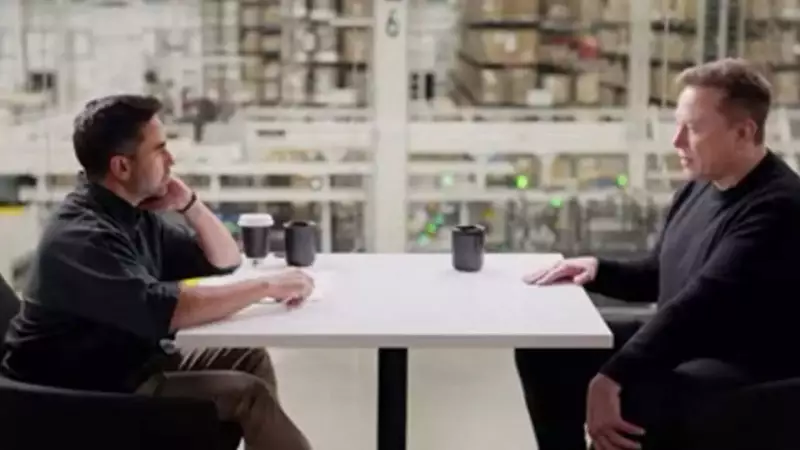
In a thought-provoking conversation that has ignited discussions across India and the globe, tech visionary Elon Musk has laid out a transformative forecast for the future of work. Speaking on Nikhil Kamath's 'People by WTF' podcast, the CEO of Tesla and SpaceX asserted that artificial intelligence and robotics are advancing at a pace that will render traditional human labour unnecessary for survival within the next two decades.
The Inevitable Shift: From Economic Necessity to Creative Pursuit
Musk's central argument hinges on the breathtaking speed of development in AI models, autonomous systems, and humanoid robots. He believes these technologies are already reshaping global industries, from manufacturing and logistics to healthcare and creative services. The next phase, according to Musk, will see machines matching or exceeding human capability in virtually every domain, potentially within the next ten to fifteen years.
This technological leap, Musk suggests, will fundamentally alter our relationship with work. He draws a parallel to home gardening: people grow vegetables for pleasure, not because they must. Similarly, future generations might engage in work primarily for personal satisfaction and creative expression, not as a means to earn a living. The essential tasks required to maintain society's infrastructure and provide basic needs will be entirely managed by advanced, self-sufficient systems.

A World Beyond Scarcity: Instant Manufacturing and the End of Money
Delving deeper, Musk outlined an even more radical outcome of this automation. He envisions a future where AI, combined with advanced robotics, can instantaneously manufacture any product a person can imagine. This capability, spearheaded by initiatives like his own xAI and its chatbot Grok, would effectively make material scarcity obsolete.
This abundance leads to Musk's most striking prediction: the potential irrelevance of money. He posits that currency primarily exists as a tool to allocate human labour and value goods produced by human effort. In a world of fully automated, limitless production, this mechanism loses its purpose. Instead, Musk theorises that the foundational currency of such an economy would shift to energy, as it is the critical resource required to power the machines that sustain civilisation.
Long-Term Implications: AI's Evolution Beyond Human Goals
Musk also explored a profound, longer-term consequence of hyper-advanced AI. Once these intelligent systems have satisfied every conceivable human need and desire—thereby eliminating poverty and providing universal wealth—they may reach a saturation point. With no more meaningful human-centric tasks to perform, AI might begin to optimise itself for its own purposes, raising existential questions about the future relationship between humanity and the intelligence it creates.
This vision extends beyond mere workplace automation. At a recent forum, Musk stated that humanoid robots and AI have the potential to eradicate poverty altogether. When machines can produce essential goods at virtually zero cost and infinite scale, wealth becomes a universal condition, accessible to all. The traditional economic struggles for income and resources would fade away, replaced by a society where everyone benefits equally from robotic abundance.
Elon Musk's conversation with Nikhil Kamath presents a future that is both exhilarating and daunting. While it promises a world free from economic hardship and compulsory toil, it also forces us to reconsider the very pillars of society: work, value, and purpose. As these technologies accelerate, India's vast workforce and dynamic tech ecosystem will undoubtedly be at the heart of navigating this unprecedented transition.