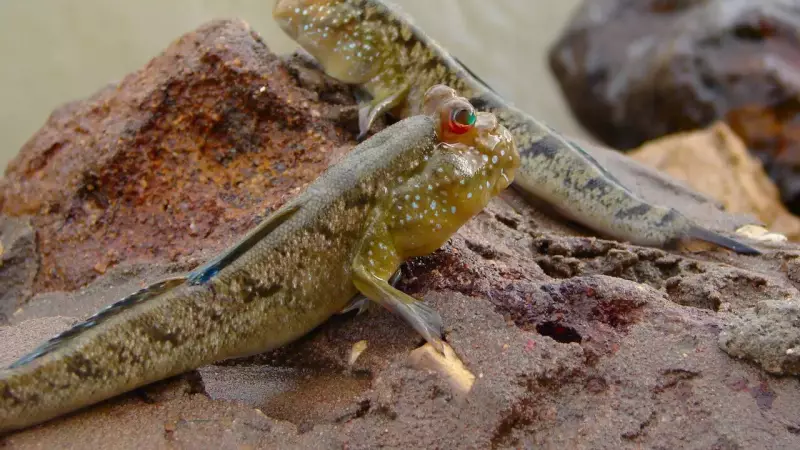
Mudskippers: The Fish That Defy Evolution by Walking on Land
When we describe someone as a "fish out of water," it often implies discomfort or being out of place. However, in the natural world, certain fish species have remarkably adapted to life outside their aquatic habitats, blurring the lines between water and land. Among these, the mudskipper stands out as a master of terrestrial living, offering scientists a unique glimpse into one of evolution's pivotal moments: the transition from aquatic to terrestrial life.
Amphibious Fish: Beyond the Mudskipper
Mudskippers are not the only fish capable of surviving on land. Lungfish, for instance, possess lungs and can suffocate if submerged for too long. The eel catfish slithers across mud to hunt insects, while grunion fish famously crawl on California beaches to lay eggs in the sand. Yet, mudskippers excel in this domain, having fully acclimated to terrestrial environments. Found in regions like Africa, South Asia, Southeast Asia, and South America, these approximately 25 species inhabit muddy coasts, mangrove swamps, estuaries, and swamplands—dynamic zones where land and sea converge.
Breathing on Land: Ingenious Adaptations
Unlike typical fish that rely solely on gills, mudskippers have developed two clever respiratory methods. First, they use skin respiration, absorbing oxygen through their moist skin, mouth, and throat, where capillaries store oxygen. To maintain moisture, they often roll in mud or splash in puddles. Second, they utilize their gills by trapping water in chambers, carrying it while moving on land. Some species even collect water from their surroundings, expanding their gill covers before resuming activities.

Walking and Hopping: Mobility on Land
Mudskippers walk using their pectoral fins, which have flexible joints resembling shoulders and elbows. This allows them to push forward, prop up their bodies, and perform push-up-like movements. This mobility likely evolved from aquatic ancestors, such as gobies, who use fins to brace against currents. Additionally, mudskippers can hop by flipping their tails into a C-shape—a reflex called a C-start—originally an escape mechanism in water that proves useful on land.
Burrows and Territorial Behavior
To cope with tides or heat, mudskippers retreat into intricate underground burrows. They dig by gathering mud in their mouths and hollowing out tunnels, sometimes trapping air bubbles for oxygen supply. These burrows feature elevated entrances that serve as observation points for monitoring food, competitors, threats, and potential mates. Males fiercely defend their territories through dramatic displays, such as wide-open mouths, raised dorsal fins, and shoving matches, reducing the need for physical combat.
Surprising Traits: Blinking and Vision
One of the mudskipper's most unexpected traits is its ability to blink, typically associated with land animals. Their eyes, positioned high on their heads like periscopes, provide a wide field of view above water. Blinking helps moisten eyes, clear debris, and protect against threats. Instead of developing new muscles, mudskippers repurpose existing ones to retract their eyeballs into fluid-filled skull cavities—an efficient evolutionary shortcut demonstrating how complex behaviors can arise without major anatomical changes.
Evolutionary Insights from Mudskippers
Mudskippers serve as a living example of evolution in action. By studying their breathing, movement, vision, and behaviors on land, scientists gain clues about how early vertebrates might have transitioned from water to land—a leap that led to amphibians, reptiles, mammals, and humans. Some researchers speculate that if climate change alters ecosystems in the future, amphibious fish like mudskippers could exploit new land environments. For now, they remind us that evolution doesn't follow neat boundaries, proving that sometimes, a fish truly can walk on land.