Hidden Magma Oceans in Rocky Planets Could Generate Magnetic Fields, Study Reveals
Deep beneath the surface of some rocky planets, layers of molten rock may be doing far more than just shaping their internal structures. Groundbreaking new research indicates these hidden magma oceans could play a crucial role in protecting planets over astronomical timescales, potentially expanding our understanding of planetary stability and habitability.
Beyond Surface Conditions: The Deep Interior Connection
The revolutionary concept doesn't focus on atmospheric conditions or surface features, but rather on processes occurring far below, under pressures that dwarf anything experienced on Earth. Scientists investigating large rocky exoplanets, commonly referred to as super-Earths, propose that molten rock subjected to extreme pressure might behave in unexpected ways. Instead of acting as an insulator, this pressurized magma could conduct electricity, opening up an entirely new mechanism for planetary magnetic field generation.
The Basal Magma Ocean: A Dense, Molten Layer
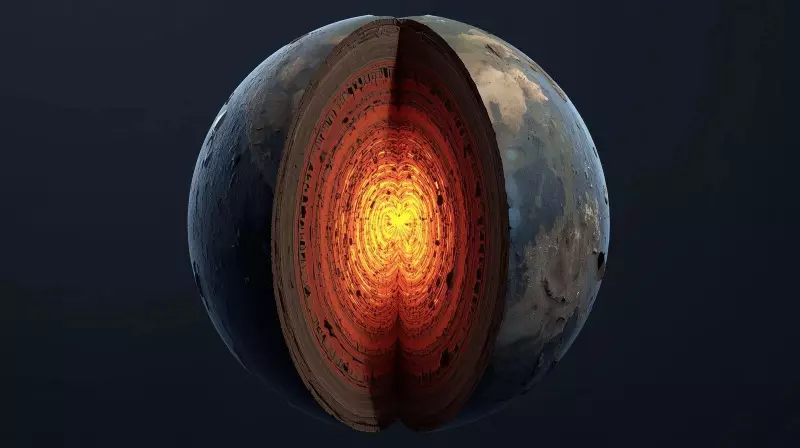
At the heart of this research lies a structure known as a basal magma ocean - a dense, molten layer that forms near the boundary between a planet's mantle and its core. While Earth is believed to have maintained such a layer only briefly after its formation, larger planets present a different scenario. Higher planetary mass creates greater internal pressure, which appears to significantly slow cooling processes. Consequently, these molten regions could persist for billions of years, long after planetary surfaces have stabilized.

Alternative Magnetic Field Generation
Planetary magnetic fields are typically associated with liquid iron cores, as seen on Earth. However, some larger rocky planets may not follow this pattern, possessing either fully solid cores or cores too fluid to sustain conventional dynamo action. This is where the magma layer becomes significant. If molten rock becomes electrically conductive under extreme pressure, its gradual movement could generate magnetic fields independently. This represents not a replacement for core-driven fields, but an alternative pathway that could operate when traditional mechanisms fail.
Pressure Transforms Molten Rock Behavior
The research, led by Miki Nakajima at the University of Rochester and published in Nature Astronomy, meticulously examines how mantle materials behave under extraordinary conditions. The team concentrated on magnesium and iron-rich minerals, common constituents of rocky planets. At pressures hundreds of gigapascals beyond Earth's internal pressures, molten versions of these minerals demonstrated electrical properties more akin to metals than conventional rock. This substantial transformation could have profound physical implications on a planetary scale.
Recreating Alien Conditions Through Experiments
To investigate these phenomena, researchers employed laser-driven shock experiments to momentarily replicate the extreme pressures believed to exist deep within super-Earths. Conducted at the Laboratory for Laser Energetics in Rochester, these brief but intense experiments were complemented by sophisticated computer simulations. Quantum mechanical models helped estimate long-term molten rock behavior, while planetary evolution models explored whether these magma layers could endure sufficiently to make a meaningful difference.
Planetary Size Determines Outcomes
The study reveals that planetary dimensions play a subtle yet crucial role. Planets with masses between three and six times that of Earth appear most likely to sustain long-lived magma oceans. Within this range, internal heat and pressure achieve an equilibrium that prevents rapid crystallization of the molten layer. Magnetic fields generated by such layers could potentially surpass the strength of those produced by metallic cores alone. While field strength matters, duration may prove even more significant - a weaker field persisting for billions of years could offer superior protection compared to a strong field that diminishes quickly.

Habitability and Unseen Interior Processes
While magnetic fields are frequently discussed in relation to atmospheric retention and surface water preservation, this research redirects attention inward. A planet's capacity to maintain an atmosphere may depend as much on deep interior chemistry as on its orbital distance from its host star. Although a magma-driven magnetic field doesn't guarantee habitability, it broadens the spectrum of planets that might remain stable long enough for other favorable conditions to develop.
The Silent Influence Beneath the Surface
Basal magma oceans leave minimal evidence at planetary surfaces, neither shaping landscapes nor influencing weather patterns. Their impact operates quietly across timescales challenging to observe directly. The research doesn't claim these layers are common or that they resolve all planetary habitability questions. Rather, it proposes an additional mechanism that might function in the background. Much uncertainty remains, but for now, this molten rock continues its hidden work, shaping planetary destinies without drawing attention to itself.