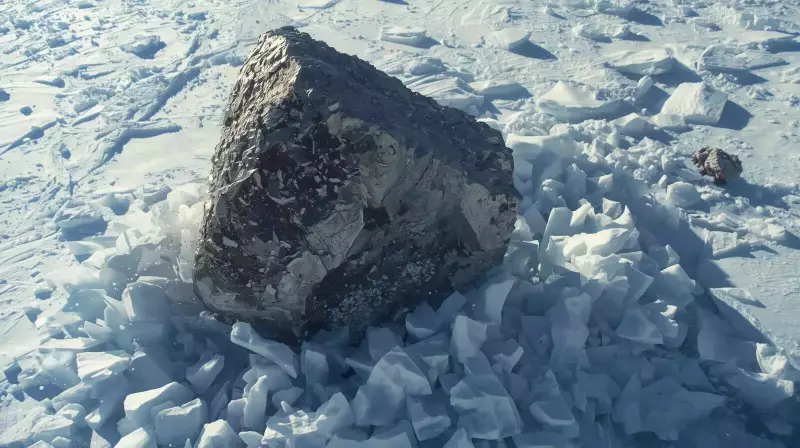
Rare Meteorite Challenges Long-Held Theory About Earth's Water Origin
Earth is frequently described as a water world, with vast oceans covering most of its surface. However, the fundamental question of how that water arrived has remained unsettled for decades. For years, scientific consensus has largely focused on asteroids and comets delivering hydrogen long after our planet formed. A recent study of a rare meteorite is now nudging that established idea sideways, offering compelling evidence that hydrogen may have been present from the very beginning.
The Meteorite That Complicates a Neat Story
The meteorite at the center of this groundbreaking research belongs to a group known as enstatite chondrites. These ancient rocks are considered the closest chemical match to the material that built the early Earth approximately 4.5 billion years ago. Traditionally, enstatite chondrites have been described as dry, with minerals that appear to hold little or no water. This assumption has fundamentally shaped planetary formation models for decades.
The specific sample analyzed in this study, designated LAR 12252, was recovered from Antarctica but maintains chemical consistency with enstatite chondrites found elsewhere. Its exceptional value lies in both its age and its remarkable resistance to later alteration. For researchers attempting to trace Earth's origins, this meteorite offers a rare and undisturbed record of our solar system's earliest days.

Hydrogen Hidden Where Scientists Were Not Looking
Researchers from the University of Oxford conducted detailed laboratory analysis using X-ray absorption techniques at the Diamond Light Source facility in Oxfordshire. While earlier studies had detected small traces of hydrogen in organic material within similar rocks, much of the hydrogen signature remained unexplained. The Oxford team pursued a different investigative approach, suspecting that hydrogen might be chemically bonded to sulphur rather than oxygen.
When they examined the fine matrix material between chondrules with unprecedented precision, they discovered surprisingly high concentrations of hydrogen sulphide. In certain areas, the hydrogen content measured several times higher than in regions studied previously. This distribution proved uneven and subtle, making it easy to overlook without targeted, sophisticated analysis.
Evidence That Rules Out Earthly Contamination
One of the primary challenges in meteorite studies involves separating original chemical signals from contamination that occurs after landing on Earth. The research team conducted careful comparisons between hydrogen-rich regions and areas showing clear signs of rust and cracking. Those damaged sections contained little or no hydrogen, creating a meaningful contrast that made it unlikely the hydrogen sulphide originated from exposure to Earth's atmosphere or water.
Instead, the hydrogen appeared securely locked within the meteorite's fundamental structure, chemically bonded to sulphur in minerals such as pyrrhotite that form under high-temperature conditions. This crucial detail helped anchor the finding firmly within early solar system processes rather than later terrestrial interference.
Rethinking How Water Could Form Naturally
If enstatite chondrites carried substantially more hydrogen than previously recognized, the implications become remarkably broad. Since Earth formed largely from this type of material, hydrogen could have been present during our planet's earliest developmental stages, embedded within its fundamental building blocks. As the young planet heated and underwent differentiation, that hydrogen could have naturally combined with oxygen to form water.
This discovery does not completely rule out later water delivery by asteroids and comets, but it significantly reduces the necessity for such external contributions. Water may have represented a natural outcome of Earth's inherent composition rather than a fortunate addition from celestial impacts. The idea shifts scientific emphasis from rare, dramatic events to more ordinary chemical processes operating during planetary formation.

What This Means for Planetary Science
The findings add substantial weight to a growing perspective that Earth's habitability was not merely accidental. Similar processes could potentially operate on other rocky planets forming close to their host stars throughout the galaxy. Hydrogen bound to sulphur proves particularly difficult to detect, and it may exist in numerous other meteorites that scientists have already examined without recognizing this chemical signature.
This research also highlights how assumptions about dryness can persist simply because certain forms of hydrogen remain challenging to measure with conventional techniques. As analytical methods continue improving, older samples in scientific collections may reveal previously overlooked details. For now, this meteorite does not provide a definitive final answer about Earth's water origins. Instead, it leaves researchers with a quieter, more profound conclusion: that our planet may have carried the fundamental seeds of its oceans from the very beginning, waiting patiently for the right conditions to allow them to surface and create the blue world we inhabit today.